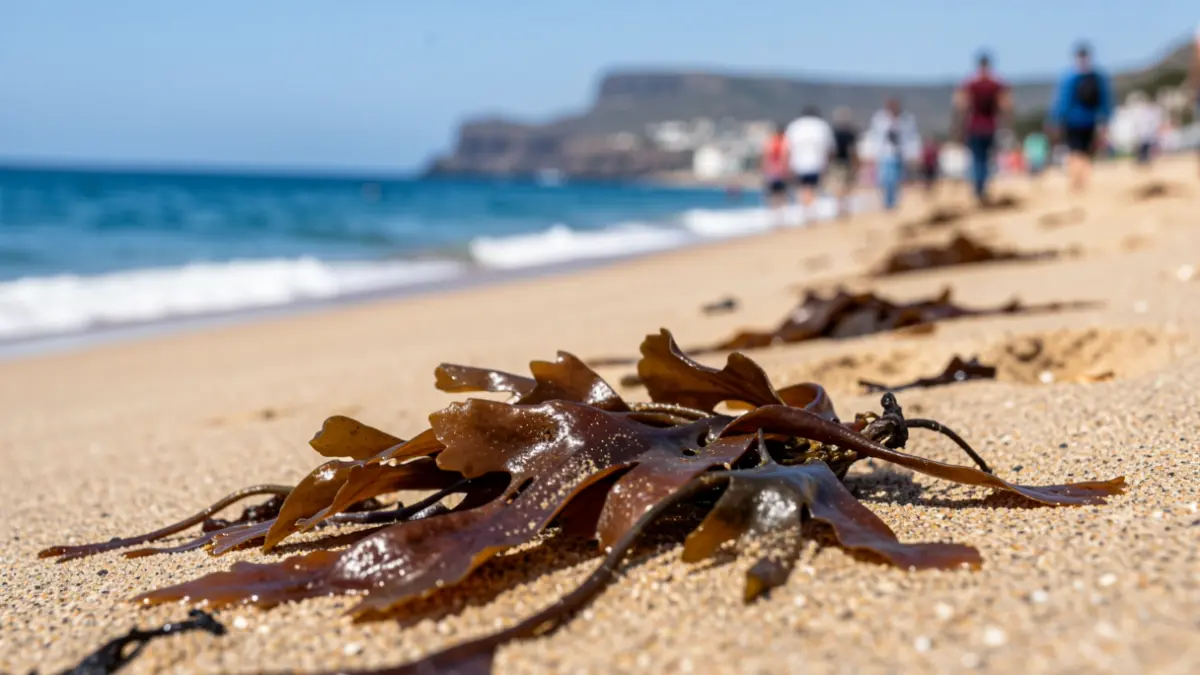
The pervasive bad odor along the coast of San Cristóbal for the past two months is a clear indicator of the proliferation of the Asian seaweed Rugulopteryx okamurae. Beach maintenance crews have collected more than double this invasive species this year compared to the entirety of 2025. While 202 tons were removed last year, as of July 17, 2026, the figure has reached 458 tons, marking a 127% increase.
This alarming figure, surpassing 450,000 kilos halfway through the year, is expected to continue rising throughout the rest of the summer, which is the season conducive to its arrival on the coast. In the first 17 days of July alone, 171,580 kilograms were collected, a volume close to the total for the entire previous year.
The accumulations are particularly concentrated at La Puntilla beach, the fishing port, the area around the San Pedro watchtower, and the section between the northern edge of the neighborhood and the breakwater of the Avenida Marítima. Workers are continuously engaged in removing this organic plant waste, but the relentless arrival of seaweed makes maintaining cleanliness a challenge.
Rugulopteryx okamurae, originating from Asia and classified as an invasive species, has caused significant damage in the Mediterranean Sea. On the island, its proliferation extends between the municipalities of the Southeast and the southern bay of Las Palmas de Gran Canaria. It was first detected in 2022 in the capital's bay, and its presence has surged this past year. The Councilor for Maritime Affairs, Pedro Quevedo, acknowledged that the problem causes serious difficulties for residents due to the foul odor emitted when the seaweed decomposes.
Municipal sources are collaborating on research projects to find uses for the collected seaweed, although they admit that, for now, the primary action is removal to prevent its spread to other areas and to avoid the situation currently faced by Andalusia. The species has colonized the seabed of the southern bay, destroying ecosystems, hindering the proliferation of native species, and complicating fishing, forcing many fishermen to travel to other waters.
From Ciudad de Mar, they emphasize that this is organic plant waste from the marine ecosystem itself, not trash. Therefore, its removal from the coastline is based on coastal management criteria when accumulations pose a risk to public health, mobility, or citizen safety.
Listed by the Ministry for Ecological Transition, this brown alga, first detected on Spanish coasts in 2015, prefers rocky bottoms and depths up to 15 meters. Its appearance is similar to 'Lobophora variegata', but the Asian variety causes a slight irritation upon contact. Its expansion is causing severe economic and environmental damage, affecting diving, swimming, fishing, and marine biodiversity.