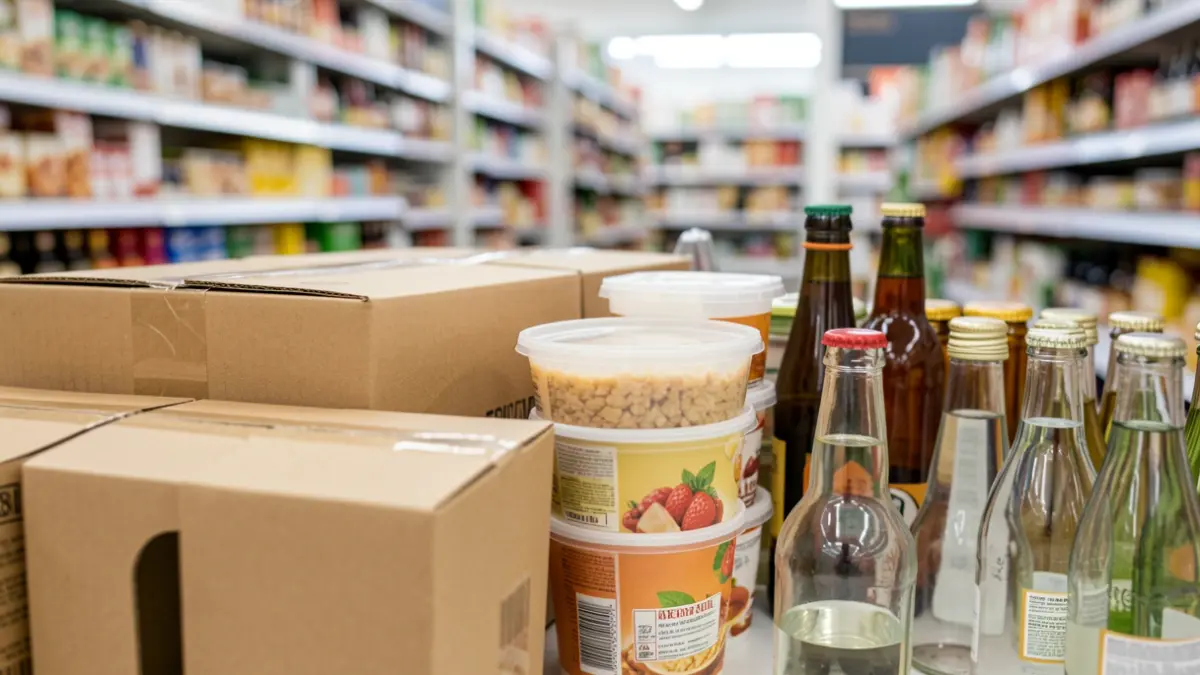
The European regulation seeks to eliminate the excessive use of plastic and establishes clear objectives for reuse, waste reduction, and recycling by 2030. From that date, the hospitality and catering sector will no longer be able to use single-use packaging for items such as ketchup, mayonnaise, sugar, or milk.
Although no immediate changes or additional costs for consumers are expected initially, sources from the distribution sector in the Canary Islands warn of potential long-term price increases. Producers and distributors will have to comply with new controls, redesign packaging, use new components, and pay fees, costs that are likely to be passed on to the final price.
The deposit, return, and refund (DRS) system for bottles, scheduled for November, may be postponed. This system involves an initial surcharge for the consumer which is later refunded, but the lack of space in many establishments for return machines poses an obstacle. The goal is to encourage recycling and the use of less polluting materials by producers.
The regulation also restricts unnecessary or excessive packaging formats, affecting e-commerce and the empty space in packages. The directive applies to all companies, but the food sector will be most impacted in terms of product design and composition in the long run, with a trend towards eliminating superfluous packaging.
Alonso Fernández, general secretary of the Association of Supermarkets of the Canary Islands (Asuican), assures that "right now, for consumers, absolutely nothing" is changing. He points out that there are internal restrictions on the content of certain packaging materials and a "broad producer responsibility" to comply with the law. He highlights that the European regulation "harmonizes" the use and composition of packaging, a task Spain has been working on for years.
One of the most significant modifications affects the amount of per- and polyfluoroalkyl substances (PFAS) in food-contact packaging. Packaging containing PFAS at concentrations equal to or greater than 25 ppb for any individual PFAS or 250 ppb for the sum of PFAS will not be allowed on the market. This impacts paper cups with fluorinated coatings, pizza boxes, and takeaway food containers.
The regulation classifies packaging recyclability into three levels (A, B, C), requiring that from 2038 onwards, only packaging with at least 80% recycled material will be accepted. Fees for marketing packaging products will be based on these ratings, with lower contributions for more recyclable packaging. Restrictions are also imposed on single-use plastic packaging, such as for fresh fruits and vegetables under 1.5 kilograms, and a EU declaration of conformity is required for all packaging.