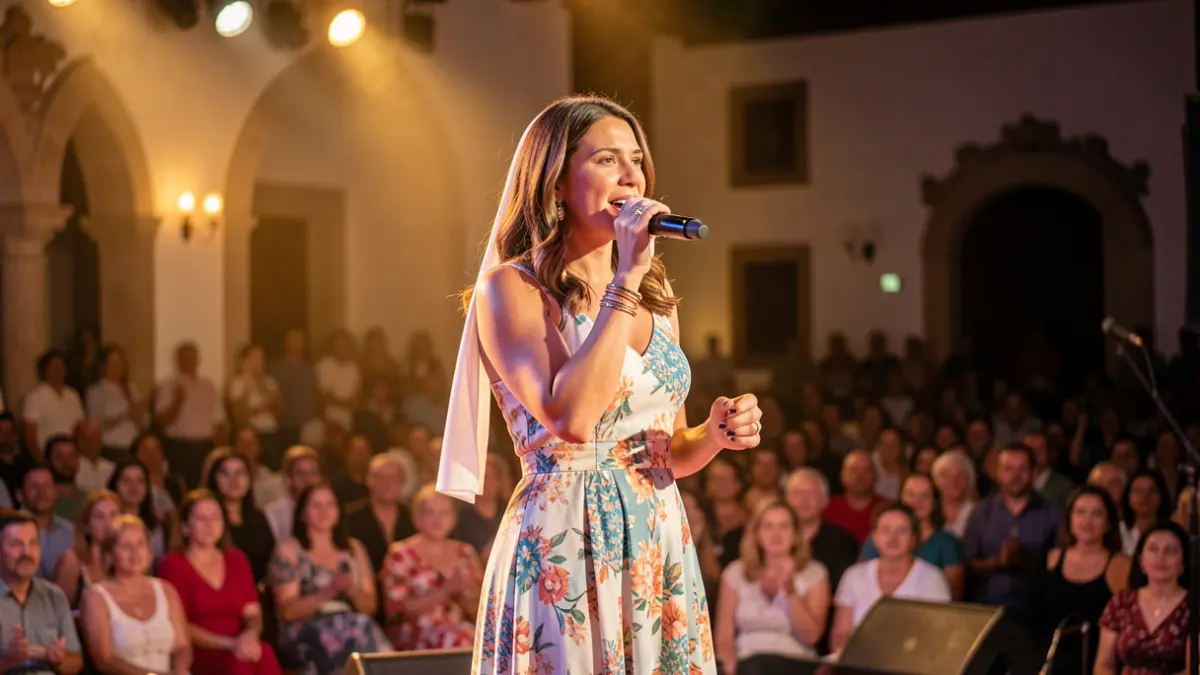
The artist, born in Las Palmas de Gran Canaria in 1962, shares her enthusiasm for the upcoming concert and reflects on her professional career and the challenges of the current music industry. Cerpa describes La Costa de los cantares as a proposal that seeks to connect directly with Africa, acknowledging its melodic and rhythmic richness.
The album features collaborations with African artists such as Guinean Eneida Marta, Cape Verdean Rufino Almeida, Congolese Matías Dorán, and Angolan Ricardo Campos. Cerpa explains that the harmony of the ensemble is achieved through stylistic affinity and the search for common sonic languages that facilitate musical mestizaje.
Regarding the digital age, Cerpa admits she is not a digital native but values the opportunities technology offers to reach a wider audience instantly, while warning about the oversupply of recordings. "Like any innovation, we must learn to manage it so that it becomes part of the solution, not a problem," she states.
The singer defends that her music, free from political contamination, aims to connect with "popular sensibility" through "eternal truths" like love or the land, arguing that music is the art that most quickly reaches people's hearts. "There's no need to rationalize anything… just feel it," she emphasizes.
On live performances, Cerpa admits feeling "a lot of" nervousness at the start of each concert, but serenity takes over when connecting with the audience. She confesses to having forgotten lyrics on occasion but accepts it as part of the profession, resorting to improvisation. "I'm not perfect, nor do I pretend to be," she assures.
Cerpa expresses her enjoyment in singing various repertoires, from Vereda Tropical to songs from Palosanto and Mestisay, feeling "like a little girl" on stage. For vocal care, she advocates for an orderly life and respecting sleep hours, without specific treatments beyond avoiding air conditioning.
Regarding current musical phenomena like 'perreo', Quevedo, or Bad Bunny, Cerpa understands them as youth's "forms of expression," even if they are not to her personal taste. "I'm more interested in asking myself what the new generations are looking for," she comments.
The artist is skeptical about the reliability of social media as a thermometer of social thought, believing that the virtual "avatar" often does not correspond to the real person. She is also not afraid of Artificial Intelligence in music, thinking it "can only make a musical stew from what already exists" and that imagination and live human connection are irreplaceable.
Cerpa declares herself "profoundly religious" and agrees with the messages of solidarity and peace from Pope León XIV, although she stresses that one does not need to be religious to subscribe to them. She shares the perception that singing "reveals the universal truth that we are made of the same clay."
The singer, who has a 23-year-old son, did not have to give up motherhood, although she acknowledges the absences of her "nomadic life." Regarding feminism, she feels closer to "historical feminists" and defends the biological principle of "being" a woman. She does not rule out future experiences in musical theater, awaiting Manuel González's ideas, and plans for albums with Latin American musicians or with a symphonic vision.