The Telde City Council has taken another step in developing its Sustainable Urban Mobility Plan (PMUS), a document that could lead to the loss of 201 parking spaces in the San Gregorio and San Juan areas. The plan, whose draft and environmental document have been open for public information for 45 business days since September 1st, aims for a radical change in how people move around the municipality, prioritizing space for pedestrians and cyclists, limiting private vehicle access in the town center, and improving public transport alternatives.
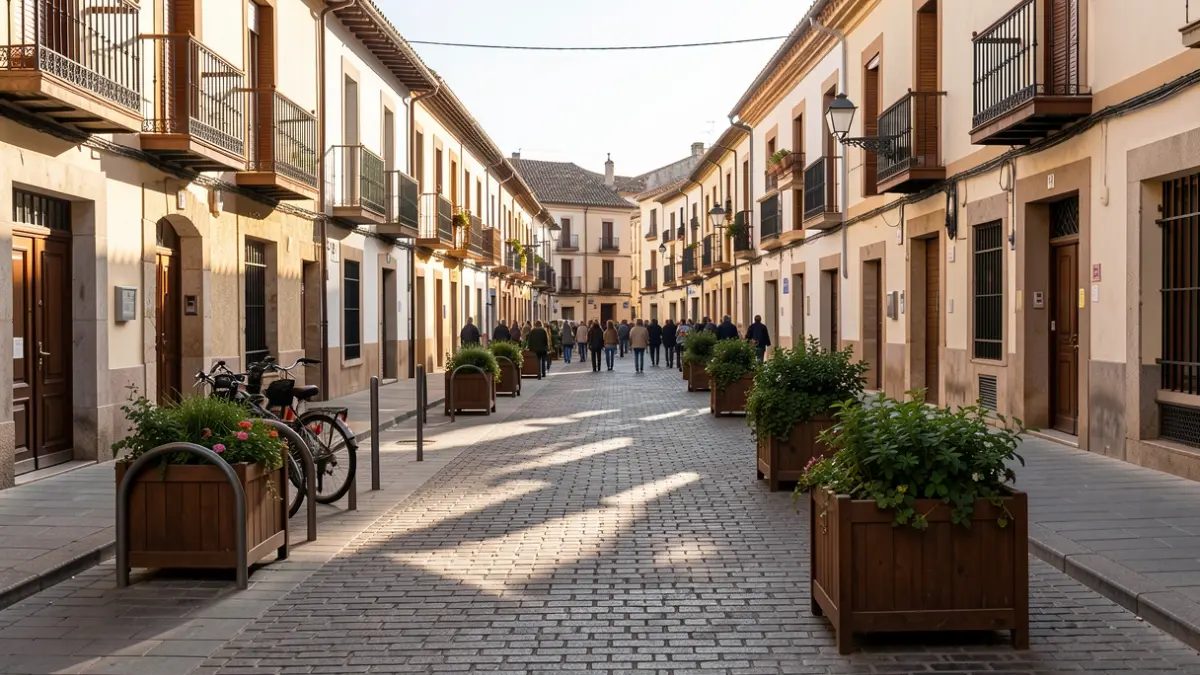
One of the most significant measures focuses on San Gregorio, where the creation of a Zero Emission Zone around its historic center and commercial area is proposed. The first phase of this action would involve the elimination of 191 parking spaces. As an alternative, the plan considers the future parking lot at the Palacio de la Cultura, with capacity for over 1,200 vehicles, aiming to transform the commercial area into a large open-air shopping center where pedestrians take center stage.
In San Juan, the proposal is similar but with a lesser impact on parking, involving the removal of ten spaces in a first stage. This intervention would cover the historic center, nearby streets, and Arnao Park, seeking to prevent through traffic in an urban fabric considered ill-prepared to handle it. Streets such as Juan Carlos I, Conde de la Vega Grande, and Don Esteban, among others, would be conditioned as restricted access routes, with a view to broader future pedestrianization.
The plan's diagnosis reveals a high dependence on cars in Telde, estimating around 250,000 daily trips by residents, of which 70.7% are made by private vehicle. The goal for 2030 is to reduce this percentage to 55%, which, according to the environmental document's calculations, would mean a 20% decrease in kilometers driven and the avoidance of approximately 9,700 tons of CO₂ annually.
To encourage alternatives to cars, the plan proposes the creation of a municipal electric public bicycle system, with a first phase of 105 bicycles distributed across 21 stations. Additionally, a cycling network of approximately 24.6 kilometers is outlined, with seven routes aiming to increase bicycle use, currently at 0.3%, to 3% by 2030.
The planned actions, with an estimated cost of 17.7 million euros, will allocate over 83% to pedestrian mobility (9.2 million) and cycling (5.6 million). This includes sidewalk improvements, safe routes for educational centers, and bike lanes. On the GC-100 road passing through Jinámar, the elimination of a traffic lane to widen sidewalks is proposed, which could result in the removal of 92 parking spaces.
The current public transport is described as "uncompetitive," with travel times significantly longer than by car. To improve the situation, a new circular line is proposed to connect the main urban centers, with a maximum frequency of 30 minutes. Furthermore, a subsidized on-demand taxi service will be studied for areas with less regular connections.
The implementation of ORA zones (regulated parking) with green spaces for residents and blue spaces for rotation in the town center is another proposal. Control would be carried out using cameras, and these would be complemented by park-and-ride facilities in central areas, potentially including trees, video surveillance, and electric charging points.
The document, still subject to potential changes after the public comment period, aims for Telde to be less dependent on cars, addressing the occupation of public space and the allocation for circulation and parking, starting with the San Gregorio and San Juan areas.