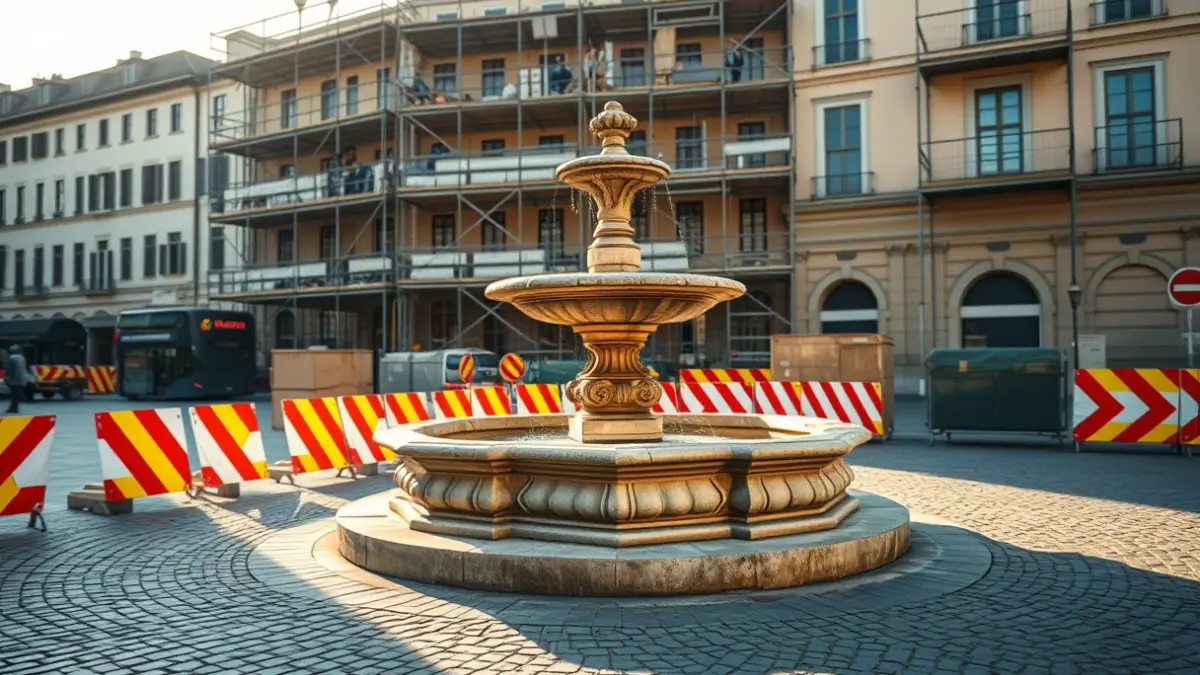
This historic monument, which has witnessed the city's evolution from its privileged position in the old town, is intrinsically linked to the history of water supply in the capital. The hydraulic infrastructure, now fenced off and without its main element, evokes the past of a vital resource that has shaped key urban events.
“"I consider that fountain an authentic monument to the history of water supply in Las Palmas de Gran Canaria."
The Santo Domingo fountain was part of the Fuente Morales water network, a system of spouts distributed throughout the city to ensure public access to water, an essential resource in an era when domestic supply was non-existent. Other important fountains of the time included the 'dog's fountain' next to the Guiniguada, a small one in Santa Ana, another in Plaza del Pilar Nuevo, and one in San Telmo Park.
Until the 18th century, water was obtained from the Guiniguada, but pollution and seasonal scarcity led to the search for alternatives. The Fuente Morales emerged as a solution for a constantly growing population and an expanding city. The new facilities were promoted by the then corregidor of Gran Canaria, who championed major projects such as street paving, sewerage, and water supply. The conduction of water from the Fuente Morales, located near Almatriche, was a considerable engineering challenge.
On August 25, coinciding with the commemoration of the Queen of Spain's day, water finally flowed through all the pillars, an event celebrated with great enthusiasm. However, the low-quality baked clay pipe with only one vent frequently broke due to high pressure, especially during storms. This initial solution proved to be a temporary 'patch'.
Faced with continuous damage, in the 19th century, elevated channels were built to prevent damage caused by rains. Over time, the Fuente Morales became obsolete, and many fountains disappeared from the urban fabric. Nevertheless, in 1890, the Municipality agreed to restore the Santo Domingo fountain for its “artistic value,” and residents of the square even requested the installation of a railing to protect it.
The Fuente Morales remained operational until 1913, when the City Council awarded the water supply contract to the English company City, which brought water from the Gamonal summit and other locations to the 'English pond' in Tafira. It was not until the 1920s that water began to reach some homes, a slow process that extended into the 1960s in certain areas of the city.
“"The history of Las Palmas de Gran Canaria cannot be conceived without the history of its water supply."
Juan Rejón's choice to settle next to the Guiniguada over five centuries ago, due to its water, underscores the historical importance of this resource. Without it, Las Palmas could have been located anywhere else on the island, and Santo Domingo Square would not be as we know it today, with its distinctive cobblestone plaza and the baroque fountain that is the centerpiece of this peculiar work of capital heritage.