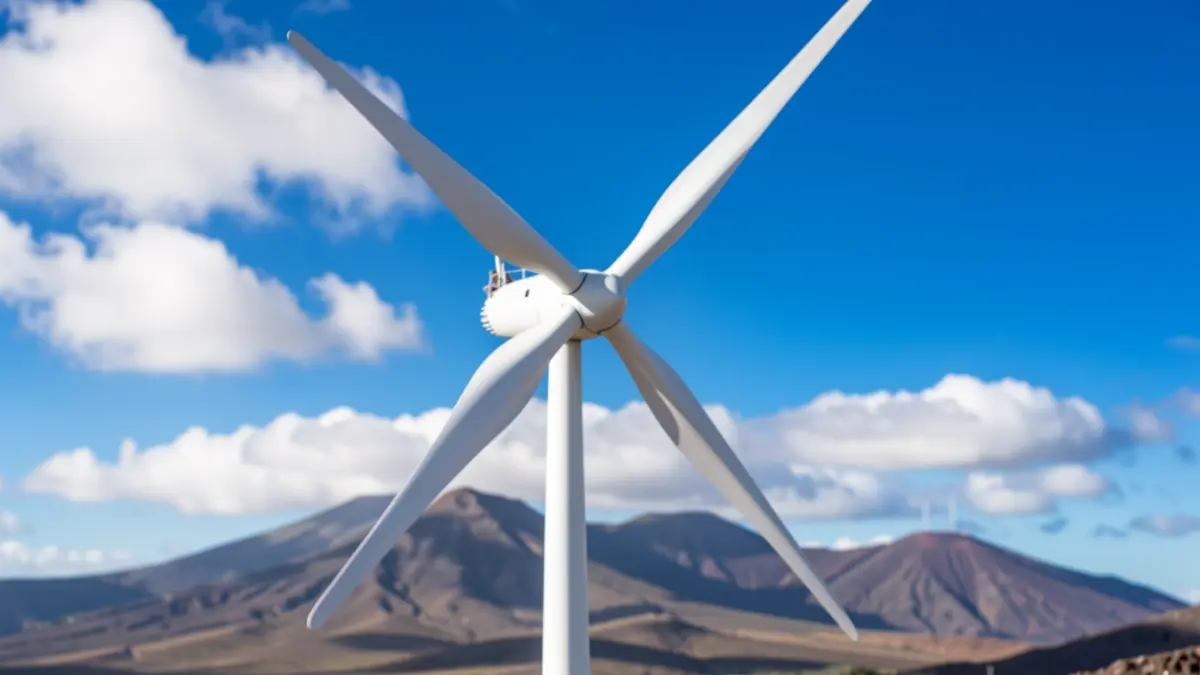
The Canary Islands are on the verge of ending the waste of renewable energy. The central government is working to define the amounts that will be received by those dedicated to storing surpluses generated by wind and photovoltaic technologies. The Minister of Ecological Transition and Energy of the Canary Islands Government, Mariano Hernández Zapata, has described this initiative as "key" and "necessary".
During the past year, clean energy spills that went unutilized reached 15% in the Archipelago, rising to 20.3% in Gran Canaria. This wasted energy had to be covered by conventional, more polluting generation.
The proliferation of wind farms since 2018 has increased the installed renewable capacity in the Islands to over 30%. However, the demand coverage by renewable sources barely reaches 22%.
The electrical system can only accommodate the energy demanded at any given moment. Therefore, at night, when the wind blows strongest and demand is lower, the energy generated by wind turbines is wasted. To solve this, storage infrastructures are needed to store these megawatt-hours for later use.
In Gran Canaria, the Salto de Chira project will help alleviate this problem once operational. Nevertheless, on this island and throughout the Archipelago, such as in Tenerife with the start of a pumping plant, batteries are necessary. The lack of a clear remuneration framework had previously hindered investment in these infrastructures.
The president of the Canary Islands Wind Energy Association (Aeolican), Raúl Macías, stated that they had been "demanding this for years." The Secretary of State for Energy, Joan Groizard, announced the creation of this remuneration framework after a meeting with representatives from the public and private sectors of the Canary Islands.
Both Aeolican and the Canary Association of Renewable Energies (ACER) are analyzing the modification of Royal Decree 738/2015, which regulates electricity production in non-peninsular territories, to incorporate remuneration for storage.
The president of ACER, Jesús Matilla, has expressed his satisfaction with the implementation of this solution, which he expects will attract more investment and boost ongoing projects. Funding for these initiatives has partly come from the European Union's Recovery, Transformation, and Resilience Plan (PRTR).
In November 2023, the Institute for Diversification and Energy Saving (IDAE) distributed 58.4 million euros among 39 storage projects in the Canary Islands, with 24 in Gran Canaria, eleven in Fuerteventura, and four in Tenerife.
The modification of the Royal Decree will broaden its scope to include batteries associated with thermal and renewable installations (hybridized) and independent storage infrastructures (stand-alone).
Another announced novelty is the change in the price signal, which will shift from the daily average peninsular price to the annual average price. However, industry entrepreneurs criticize the continued use of the peninsular reality as a reference, which differs significantly from the islands' situation.
Raúl Macías points out the extra cost for non-peninsular systems, where clean energy is generated at 65.28 euros per megawatt-hour compared to 200-202 euros for polluting energy.
Jesús Matilla laments that the Canary Islands, like the Balearic Islands, Ceuta, and Melilla, continue to be linked to the mainland in aspects such as electricity, without being defined by their own reality.