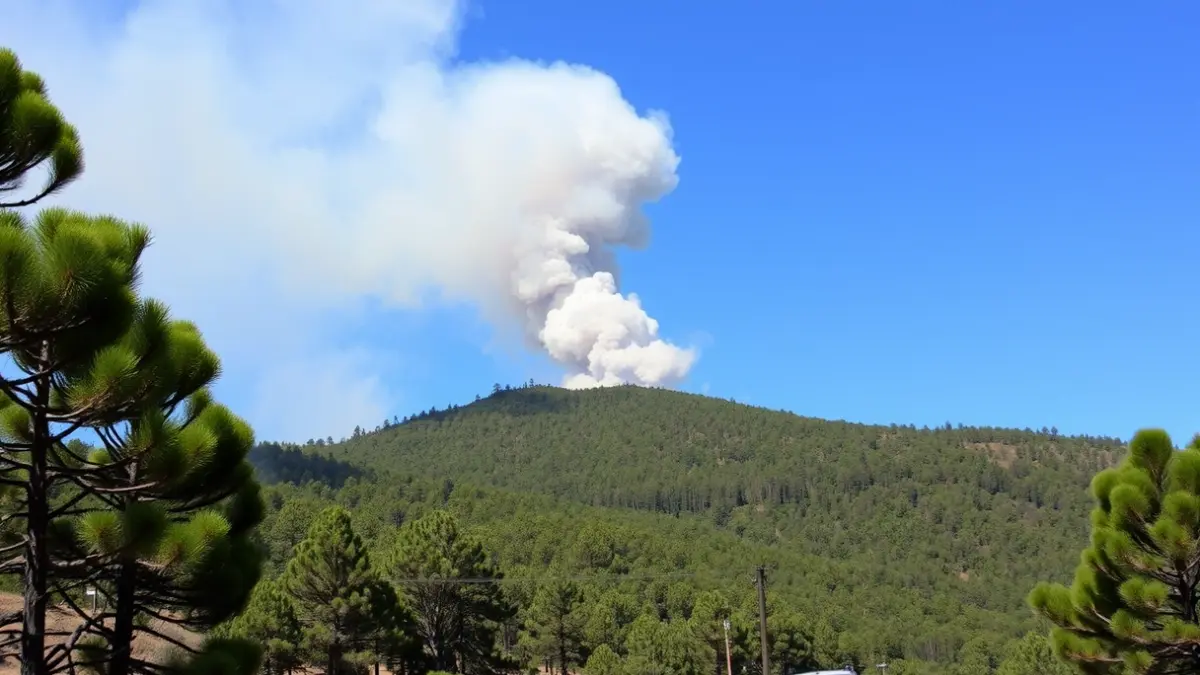
The Vice-Ministry of Emergencies of the Government of the Canary Islands has issued a warning about the territory's vulnerability to fires, despite concentrated rainfall from storms like Therese. Over 30% of the Canary Islands' 578,000 hectares of forest land, which accounts for nearly 78% of the total area, presents a significant risk. Factors such as agricultural abandonment, forest continuity, and climate change have extended the danger window.
“"These layers that prevent moisture from staying in the soil are drying out. We cannot let our guard down."
Rising temperatures and recent droughts have disrupted the natural balance of the forests. Even though some islands have received the equivalent of three winters' worth of rain in just a few weeks, humidity levels have not recovered, leading to water stress that turns the land into a “tinderbox.” Vegetation grows, but so does combustible material, necessitating constant vigilance.
The autonomous firefighting campaign for 2026 will feature a large-scale operation, designed for rapid response in a fragmented territory with complex topography. The operation will mobilize 1,929 personnel, 208 ground vehicles, and 18 aerial assets, confirming wildfire suppression as a top priority in Canary Islands' emergency planning.
The island councils (cabildos insulares) bear the primary responsibility for the initial response. Tenerife, with its extensive forest area and challenging terrain, concentrates the largest volume of resources, contributing 88 personnel, 54 material assets, and two aerial assets. Additionally, the Tenerife Cabildo signed an agreement with Defense for the deployment of approximately 2,500 military personnel on the island. Gran Canaria will contribute 178 personnel, 25 material assets, and two aerial assets, allocating five million euros from the ‘green cent’ tax to prevention. La Palma will add 237 personnel and 37 assets, El Hierro 115 personnel and 33 assets, and La Gomera 112 personnel and six ground assets.
When a fire escalates, the autonomous response system comes into play, involving the Forest Fire Intervention and Reinforcement Teams (Eirif) and the Emergency and Rescue Group (GES). State support is provided by the Military Emergency Unit (UME), with 150 personnel and 24 assets, and the Ministry for Ecological Transition (Miteco), which will contribute 65 personnel and ten assets. Coordination among all administrations is crucial for a synchronized response.
Technology is also being integrated into prevention efforts, with night-vision drones in Tenerife and continuous monitoring systems in Fuerteventura, including a ‘megadrone’ for tracking hotspots. Training is essential, and a drill in Moya, Gran Canaria, will test institutional coordination. However, authorities emphasize that public involvement in prevention is indispensable, as “fire no longer understands seasons” and the threat can emerge at any time.