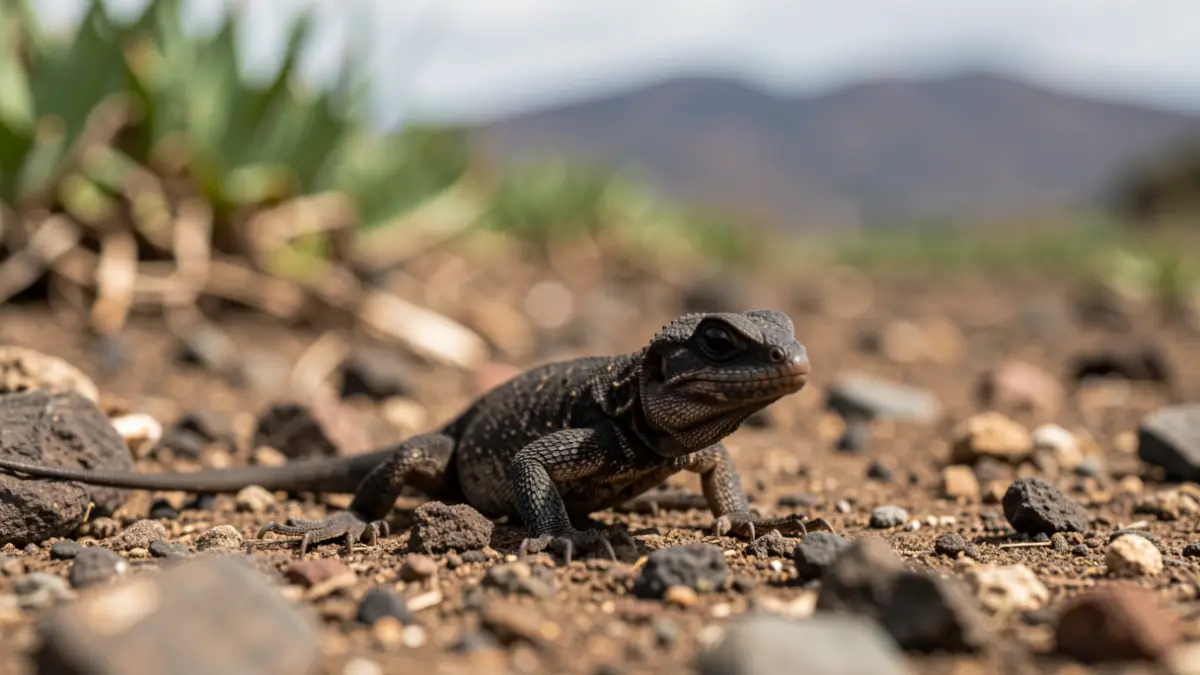
The loss of biodiversity in the Canary Islands due to the pressure exerted by cats on endemic lizard populations is an increasingly evident reality. A new study has discovered that tizón lizards are becoming smaller.
A research group from the National Museum of Natural Sciences (MNCN-CSIC), the University of La Laguna (ULL), and the Ornithology and Natural History Group of the Canary Islands (GOHNIC) analyzed over 200 tizón lizards in similar habitats, differentiating between those near or far from feline colonies.
The research, published in the journal Biology Letters, concludes that cats generate "very severe effects" on the populations of this endemic lizard, with repercussions throughout the ecosystem. Lizards are a key piece as seed dispersers and prey for other predators, acting as "an indicator of the state of the Islands' ecosystems," according to ULL biologist Juan Carlos Rando.
Contrary to popular belief, the study reveals that even domestic cats with outdoor access and those living in colonies hunt lizards, often without consuming them. "Around 20 to 40% do not end up consuming them," notes Rando, suggesting an "instinctive behavior." Up to 14 lizards have been detected in prey remains from a single feline colony in Tenerife, where 22 colonies were studied.
Researcher Airam Rodríguez from the MNCN points out that the impact of feline colonies is not limited to predation but also influences the structure of lizard populations and their size. The location of the colony, whether in the center of Santa Cruz or in the Rural Park of Teno, is also a determining factor in its impact.
The research highlights the inadequacy of the 2023 Animal Welfare Law, which focuses on the CER method (capture-sterilize-return). Scientific data suggest this method does not effectively reduce cat populations in open environments, requiring at least 98% sterilization and no migration for it to be effective.
Beneharo Rodríguez (GOHNIC), a co-author of the study, concludes that "integrated management policies that consider the protection of native fauna in the vicinity of cat colonies" are needed.
Another study published in European Journal of Wildlife Research questions the legal "permissiveness" towards cats. Experts propose more homogeneous legal treatment with dogs, suggesting the use of leashes or enclosed areas. They propose following the model of Canberra (Australia), relocating free-roaming cats to sanctuaries.
The research emphasizes that cats should be considered "exotic" and "invasive" species due to their severe impact on biodiversity, surpassing dogs in this regard, with cats attributed to the extinction of about 60 species compared to 10 for dogs.