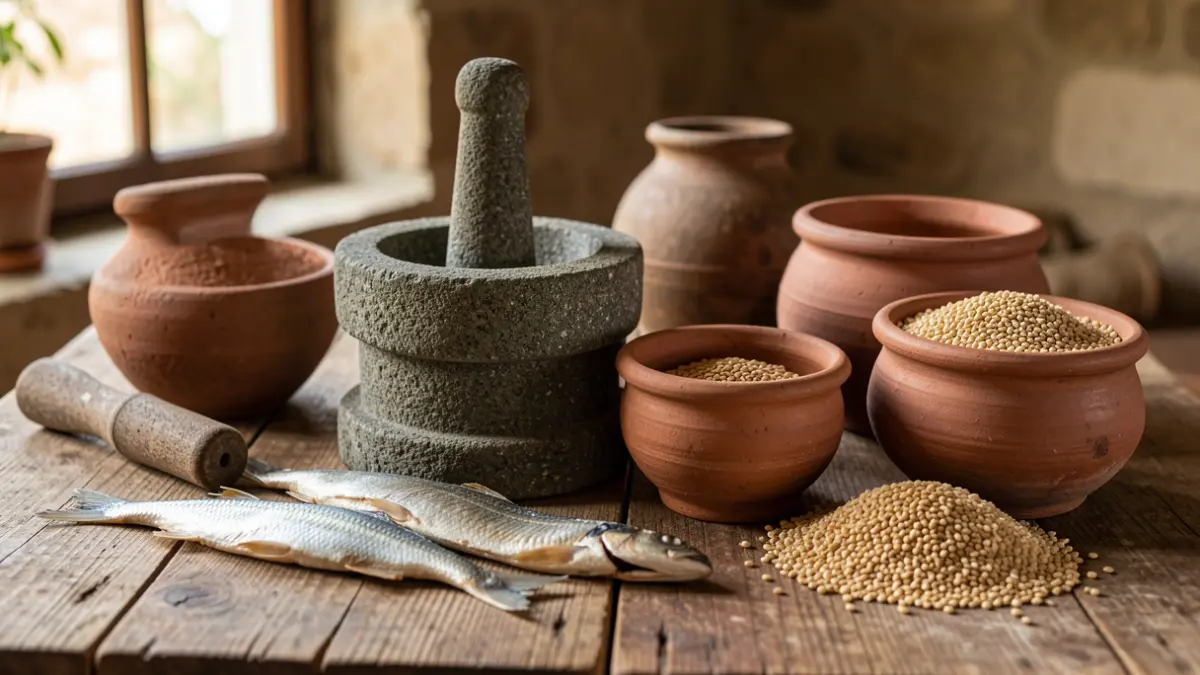
The ancient Canarians, known as Guanches, possessed a surprisingly advanced repertoire of culinary techniques, comparable to those used in modern haute cuisine. Archaeological research and the analysis of historical chronicles shed light on how they prepared, preserved, and consumed their food, revealing methods that have endured through the centuries.
Museums such as El Museo Canario and MUNA in Santa Cruz exhibit tools like gofio roasters, stone grinders, cutting slabs, and various food preparation utensils. Fish and mollusks, fundamental to their diet, were prepared in various ways, including fresh consumption, roasting, or in stews. Archaeologist Carmen Gloria Rodríguez has documented evidence of fish scales and worked goat horns in sites on Gran Canaria, such as Lomo de Los Melones and Playa Chica de Sardina del Norte, suggesting their use as scaling tools.
Food preservation techniques were crucial. For fish, salting and sun-drying were common methods, also cited by chroniclers and still present in today's Canarian gastronomy with salted fish and jareas. Vegetables were dehydrated, like figs, or stored in caves and silos, especially in Gran Canaria, where laurel leaves were used as a natural insecticide to preserve seeds, as evidenced in the Cenobio de Valerón.
Gofio, a word of indigenous origin, was made by toasting barley and wheat grains, then grinding them and mixing them with water, milk, or butter. This flour, which keeps for a long time, was a staple food. In times of scarcity, a type of gofio was made from fern rhizomes. Milk production from goats and sheep was primary, yielding mainly clarified butter; cheese-making appears to be an innovation after the arrival of Europeans.
For cutting and butchering animals, rocks like phonolite and obsidian were used. Phonolite, more resistant, was preferred for butchering animals, while obsidian, more fragile, was used for fine cuts. Meat was also dried in strips, a common practice in Fuerteventura according to French chronicles.