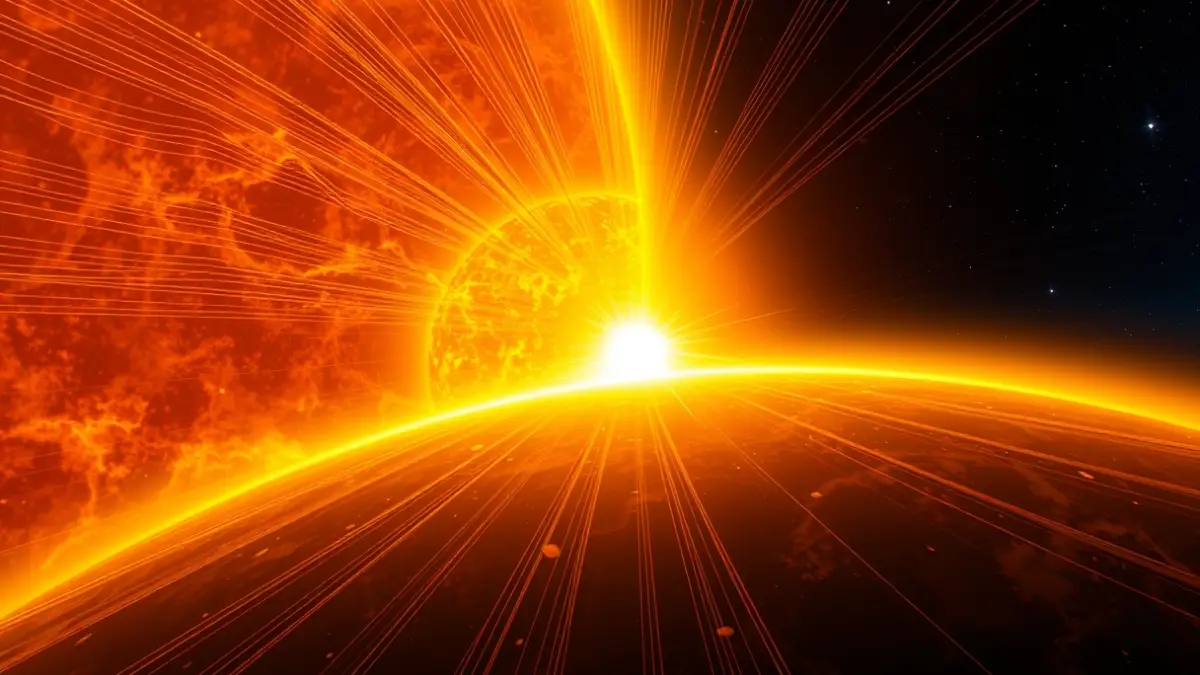
The atmosphere surrounding the Sun, known as the solar corona, reaches temperatures of millions of degrees, a striking contrast to the mere 6,000 degrees of its surface. This enigma, first posed in the mid-20th century, has puzzled scientists for decades. The most accepted theory suggests that this heating is due to the release of energy through small events, such as the 'nanoflares' proposed by astrophysicist Eugene Parker.
Thanks to recent space missions like IRIS (NASA) and Solar Orbiter (ESA/NASA), phenomena resembling these small-scale explosions have been observed. However, their widespread detection has been a challenge, as 'nanojets' are tiny and ephemeral, making them difficult to observe with current technology. Future missions, such as MUSE (NASA), scheduled for launch in 2027, are expected to significantly improve detection capabilities.
“"Theory states that for the solar atmosphere to be at such a temperature, these nanojets must be occurring across the entire solar surface simultaneously."
The team of researchers from the IAC and ULL has proposed a physical mechanism explaining how these 'nanojets' originate and has developed predictions that will facilitate their identification in future observations. These energy bursts are caused by a process called "magnetic reconnection," where two opposing magnetic fields meet, breaking their configuration and releasing immense amounts of stored energy that propel plasma in narrow, high-velocity jets.
Although magnetic reconnection cannot be directly observed, its effects on the plasma are detectable. The model developed by the scientists shows the specific signals that should appear in observations, representing a crucial step towards understanding small-scale dynamics in the Sun and how magnetic energy is released in astrophysical plasmas.