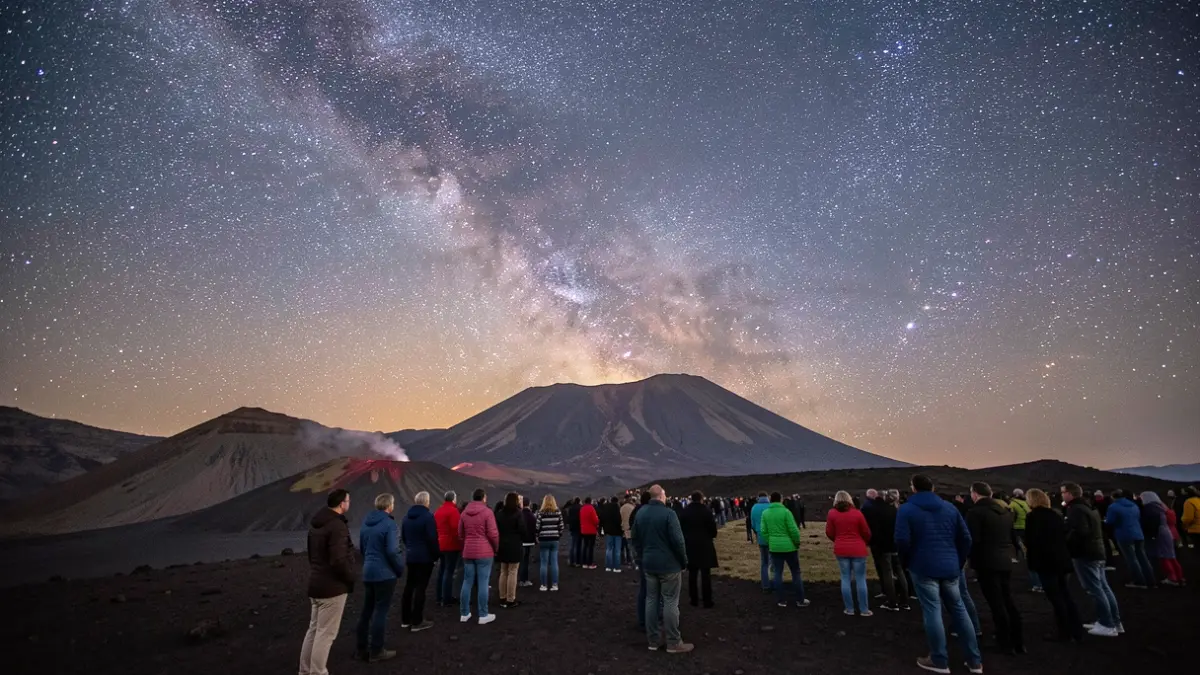
The nights of Wednesday, August 12, to Thursday, August 13, are ideal for observing the Perseids, one of the most anticipated astronomical events of the summer. This year, the phenomenon will reach its peak between 02:00 and 03:00 AM on Thursday, with a forecast of up to 100 meteors per hour.
Jonay González, research coordinator at the Canary Islands Institute of Astrophysics (IAC), highlights that the absence of moonlight, due to the new moon following a recent eclipse, will enhance the visibility of these shooting stars. It is not necessary to travel to high-altitude areas; simply moving away from the light pollution of cities like Las Palmas de Gran Canaria or Santa Cruz de Tenerife is sufficient.
González points out that the Canary Islands boast some of the best skies in the world for astronomical observation, allowing for clear enjoyment of the phenomenon almost anywhere away from urban centers. Authorities recommend avoiding unnecessary travel to summit and forest areas, especially due to the risk of crowds and fires.
The Perseids, also known as the tears of San Lorenzo, will continue to be visible on Thursday and Friday nights, although with a lower frequency of meteors.
This phenomenon occurs when the Earth passes through the trail of dust and ice left by comet Swift-Tuttle. The particles, some the size of a grain of sand, enter the atmosphere at speeds of up to 250,000 kilometers per hour, generating the characteristic flashes of light known as shooting stars. Their name comes from the constellation Perseus, the point from which they appear to emanate.