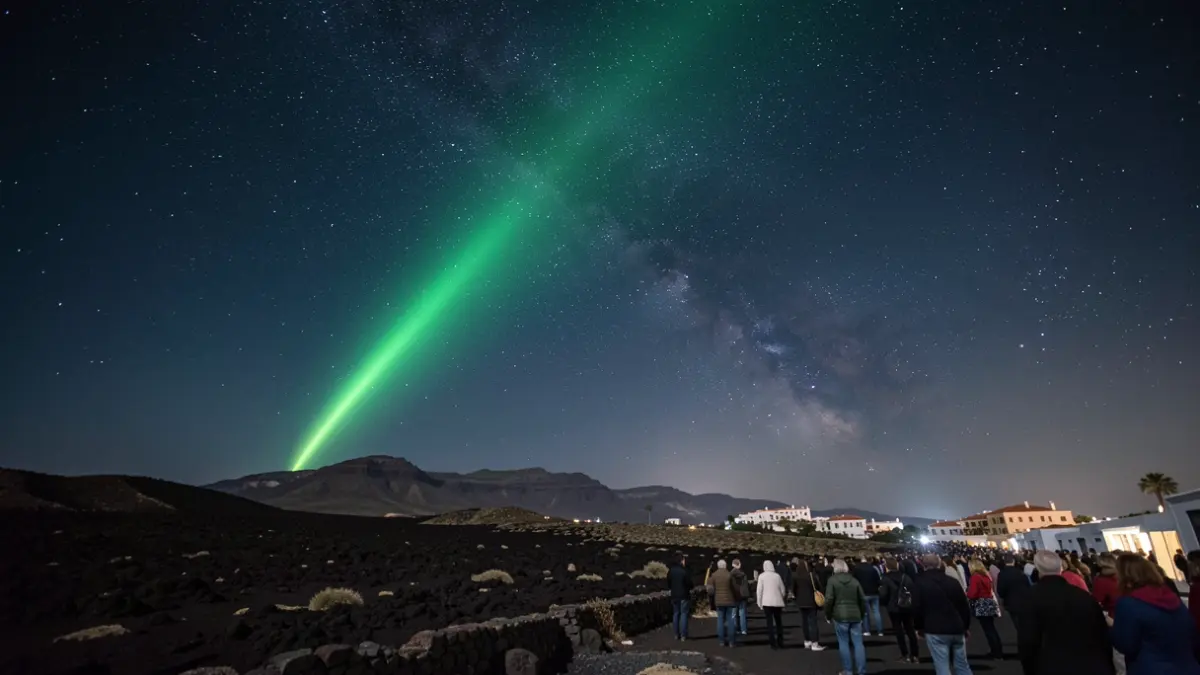
A luminous emerald-colored phenomenon streaked across the sky of the Canary Islands on Saturday night, causing astonishment and numerous calls to the 112 emergency line. Scientists from the Canary Islands Institute of Astrophysics (IAC), in collaboration with a Slovak team, are analyzing spectral data to determine the exact nature of the object. Preliminary analyses suggest it was a meteor between 10 and 30 centimeters, comparable to the size of an orange or a soccer ball.
IAC astrophysicist Javier Licandro, an expert in meteorite surveillance, confirmed that the object headed towards the constellation Pegasus, falling on the eastern and northeastern slopes of the islands. This trajectory facilitated its simultaneous visibility in La Palma and Tenerife.
The meteor was captured by the Gran Telescopio Canarias (GTC), located at the Roque de los Muchachos Observatory in La Palma, and by the cameras of the AMOS (All-Sky Meteor Orbit System) experiment, installed at the Teide and Roque de los Muchachos observatories.
Due to its small size, it is estimated that the space rock burned up completely upon entering the atmosphere, without impacting the ground. Had it been larger, it would most likely have fallen into the ocean, far from the islands.
The analysis of data from the AMOS system will allow for the triangulation of the meteor's trajectory and the study of its composition and brightness. This information is currently being processed by a Slovak scientific team.
The AMOS system, consisting of a fisheye lens, an image intensifier, a projection lens, and a digital video camera, is designed for meteor observation and could have applications in other fields such as meteorology or aeronautics.
Prior to scientific confirmation, the 112 emergency service received numerous calls around 11:37 PM describing the phenomenon as a "point of light" crossing the sky.