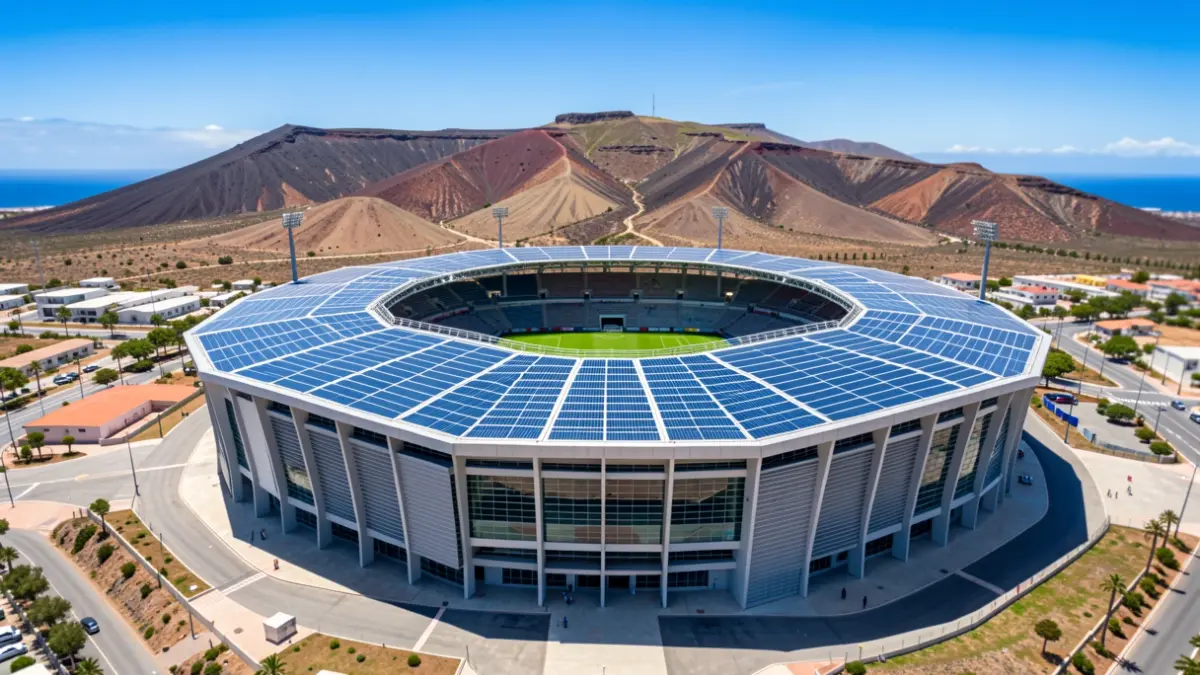
The Insular Institute of Sports has tendered for the second time the renovation and expansion of the Gran Canaria Stadium, with the goal of the Siete Palmas venue achieving an A energy rating and zero emissions. A key measure includes installing a self-consumption photovoltaic plant on the roof, with a peak capacity of 2.5 megawatts (MW).
The 'La Nube' project plans for the use of bifacial solar panels on the facades and roof, totaling between 2 and 5 MW. This photovoltaic generation is estimated to cover approximately 35% of the stadium's annual electricity demand, leveraging the diffuse radiation characteristic of the Canarian climate.
In addition to solar photovoltaic energy, four wind turbines, each with a capacity of 10 kilowatts (kW), will be installed. The sustainability strategy is further enhanced by the use of solar thermal energy and aerothermal systems, with a feasibility study planned for shallow geothermal energy to climate control the building and produce domestic hot water.
With all the proposed renewable sources, it is anticipated that 45% of the stadium's annual electricity demand will be met by clean energy. For heating and cooling, air-condensed heat pumps and chillers will be used, located on the accessible roof of the North end.
The project's technical report highlights that the proposed system, featuring reversible heat pumps, will efficiently meet heating and cooling demands, making heat production free during intermediate seasons. This represents a significant improvement in the building's energy efficiency and operational cost savings.
The necessity report emphasizes the importance of an efficient building envelope to maximize the use of generated clean energy. The architectural design will integrate active and passive energy-saving systems, aiming for 'La Nube' to become a benchmark for sustainability and efficiency.