The initiative, promoted by the Canary Islands Government's Ministry of Ecological Transition and Energy in collaboration with the Ministry of Education, incorporates 29 new centers, while 17 continue from previous editions. This expansion consolidates the educational network and allows for addressing the different island realities concerning climate change.
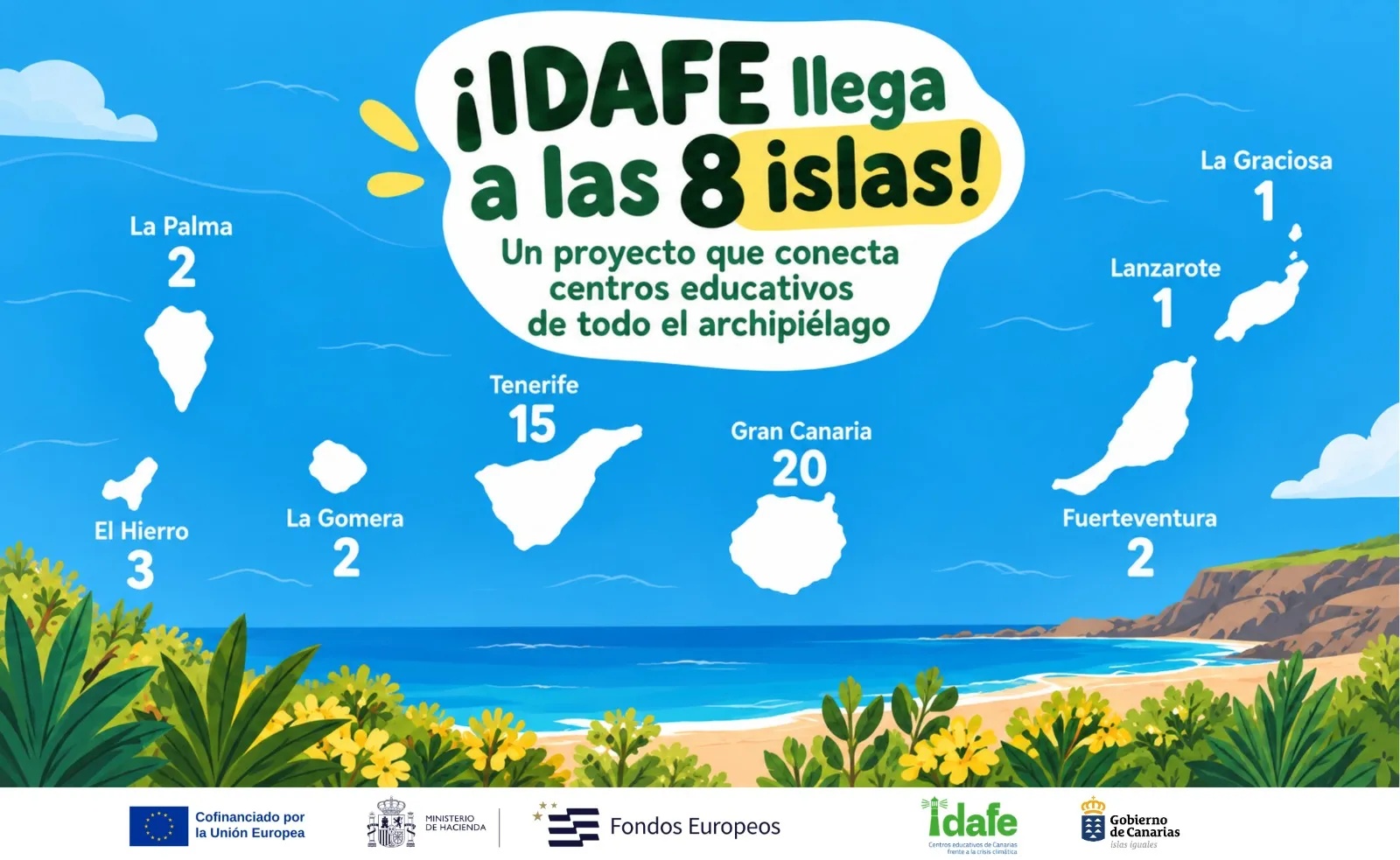
The territorial distribution of participating centers is as follows: 20 in Gran Canaria, 15 in Tenerife, three in El Hierro, and two each in La Palma, La Gomera, and Fuerteventura. Lanzarote and La Graciosa each have one participating center.
The project encourages students to understand the impact of climate change on their immediate surroundings and to propose adaptation measures. Through teacher training and the use of educational resources tailored to the Canary Islands' environmental reality, students analyze their own schools, identify areas most exposed to heat, and detect other climate-related needs to develop appropriate proposals.
In addition to analyzing the school environment, the project covers impacts on water, changes in species distribution, and social vulnerability to climate change. These activities connect scientific knowledge with everyday situations, enabling students to identify problems, work in teams, and propose solutions.
The presence across all eight islands broadens IDAFE's territorial reach and opens new possibilities for exchanging experiences among educational communities. Participating teachers will receive specialized training, technical support, and educational materials. The III Regional IDAFE Meeting is planned to present the work carried out and share learnings.
The IDAFE project is co-financed by the European Union through the Canarias FEDER 2021-2027 Programme and is part of the Canary Network of Educational Centers for Innovation and Quality of Sustainable Learning (Red Canaria-InnovAS). GESPLAN is responsible for its execution.