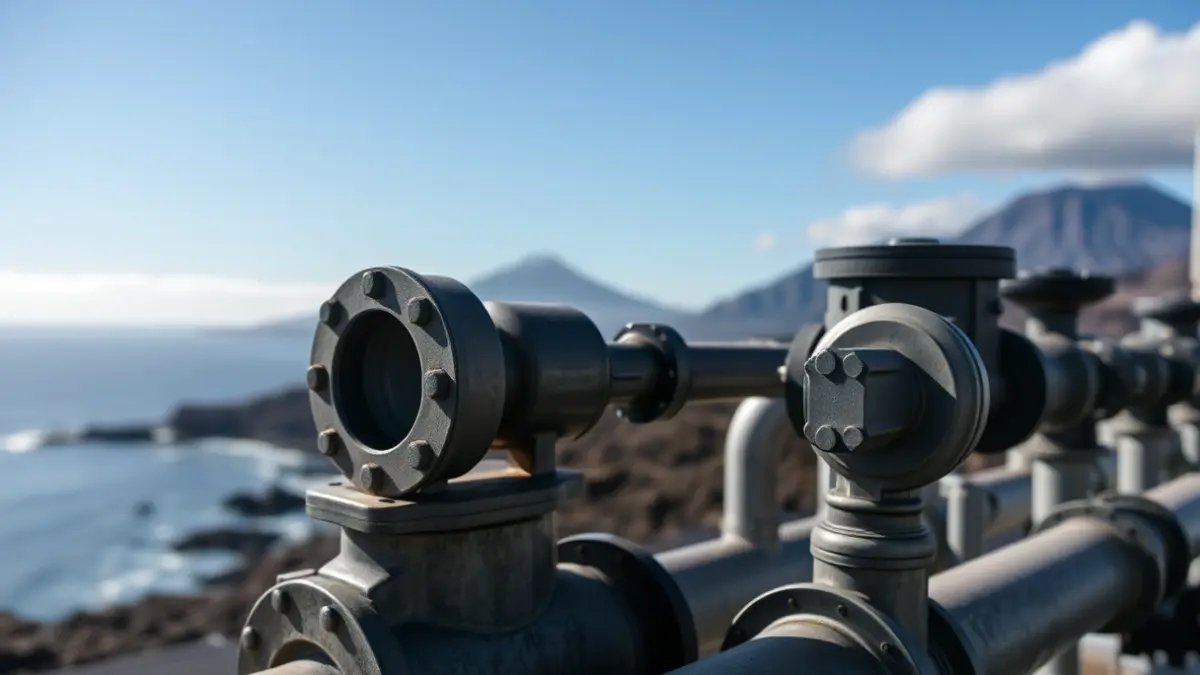
Desalination has arrived in La Palma under an emergency regime, bypassing ordinary bidding procedures and the guidelines of the Island Hydrological Plan of the La Palma Hydrographic Demarcation (2021-2027). This plan does not foresee the execution of industrial water production systems in the municipality of Breña Baja, where the plant has been installed.
Law 9/2017 on Public Sector Contracts (LCSP) allows for exceptional contracting in situations of catastrophe, serious danger, or national defense. It is assumed that one of these circumstances has been invoked to justify the emergency report for the contract to implement the industrial water production system on the island.
A flow of that style, a “complete consulting-execution cycle,” where a company analyzes the problem, proposes the solution, and then executes it. Although not illegal per se, it requires additional guarantees of transparency and competition, as provided by the LCSP.
It is noteworthy that the company responsible for this emergency action had previously been awarded a hydraulic efficiency study in the same Eastern Region, which includes Breña Baja. This study, titled “Service of analysis, diagnosis, and proposal of measures to improve the hydraulic efficiency of territorial hydraulic infrastructure systems for the supply of drinking water to the population” (Lot 1), consisted of three main phases: collection and analysis of existing documentation, diagnosis of the current state, and a program of measures. It would be crucial to determine if this program considered the implementation of desalination systems in the area.
Processing through the emergency route, while justified for immediacy, bypasses normal control mechanisms, making the process legally sensitive. Article 70 of the LCSP requires measures to prevent unjustified competitive advantages when a company has participated in previous studies. Furthermore, an emergency declaration does not exempt compliance with the hydrological plan or current urban and environmental regulations.
The Island Hydrological Plan of La Palma (2021–2027), approved by Decree 6/2025, has regulatory status and is binding on the Administration. If the plan only suggests studying desalination, it does not directly order its implementation. It is essential to differentiate a water emergency declaration, which allows for obtaining unconventional resources, from emergency contract processing, which is a tool for immediate action, not for implementing structural public policies.
There is growing concern that the archipelago's water guidelines may be largely influenced by sector companies, transforming “technical assistance” into “decision-making.” This could lead the Administration to become a mere processor of commercial solutions rather than a guarantor of the general interest. Desalination, initially presented as a “patch” against drought or volcanic emergency, risks becoming a structural change in La Palma's water model, shifting investments from network efficiency and aquifer recovery towards industrial water production with a long-term presence.