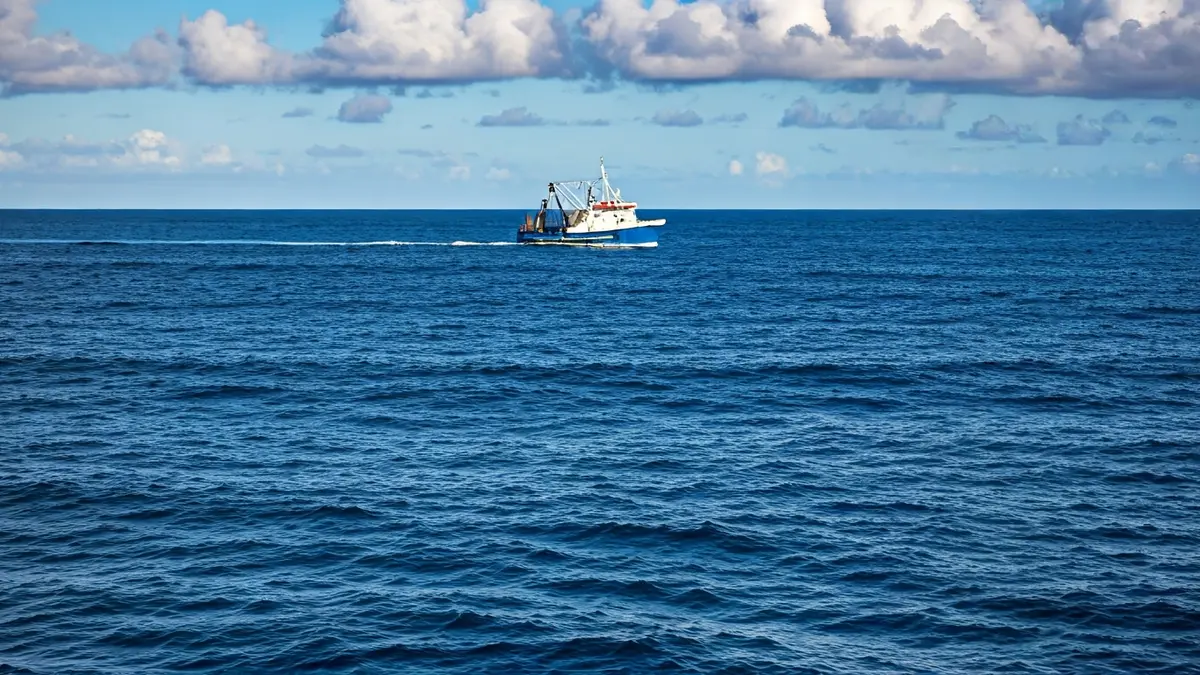
Artisanal fishermen in northern Lanzarote, home to Spain's largest marine reserve spanning 70,700 hectares, alerted the General Directorate of Fisheries of the Canary Islands Government about a significant reduction in their catches. Between 2018 and 2020, peaks exceeded 400 tons, but by 2023, they barely reached 210 tons, representing a 48% drop. This decline primarily affected species such as hake, alfonsino, forkbeard, and red porgy.
Initially, sector workers, like Santiago González, 49, were convinced that sharks were to blame. They practice deep-sea fishing, an artisanal method in waters between 200 and 800 meters deep, where sharks would intercept fish during their ascent. González described the mako shark as “super bad” and “opportunistic,” lamenting that it “gets everywhere” and “bites without hunger.”
“"As soon as I cast two or three times and catch several fish, they get underneath and don't let me do anything."
Concerned by this, the General Directorate of Fisheries asked the University of Las Palmas de Gran Canaria (ULPGC) to investigate. Researchers from the ECOAQUA University Institute joined artisanal fishing fleets from Caleta de Sebo (La Graciosa) and Órzola (Lanzarote) between July 2022 and June 2023, evaluating 317 fishing attempts. The results were conclusive: only two clear cases of shark predation were recorded, ruling out their significant impact.
The research, led by José Juan Castro and David Jiménez-Alvarado from ECOAQUA, focused on the correlation between catches and the North Atlantic Oscillation (NAO), an atmospheric pattern measuring the pressure difference between the Azores anticyclone and the Icelandic low-pressure center. The NAO modulates trade winds and water temperature, affecting fish larval survival. A negative NAO phase between 2014 and 2017 coincided with a species “boom,” while the subsequent positive phase aligned with catch declines from 2021 onwards.
The findings, published in the scientific journal Marine Environmental Research, suggest that traditional fisheries management tools are insufficient in the face of climate variability. Scientists recommend integrating indices like the NAO to create “early warning systems based on climate forecasts,” which would allow fishermen to anticipate periods of low productivity and adjust their strategies.