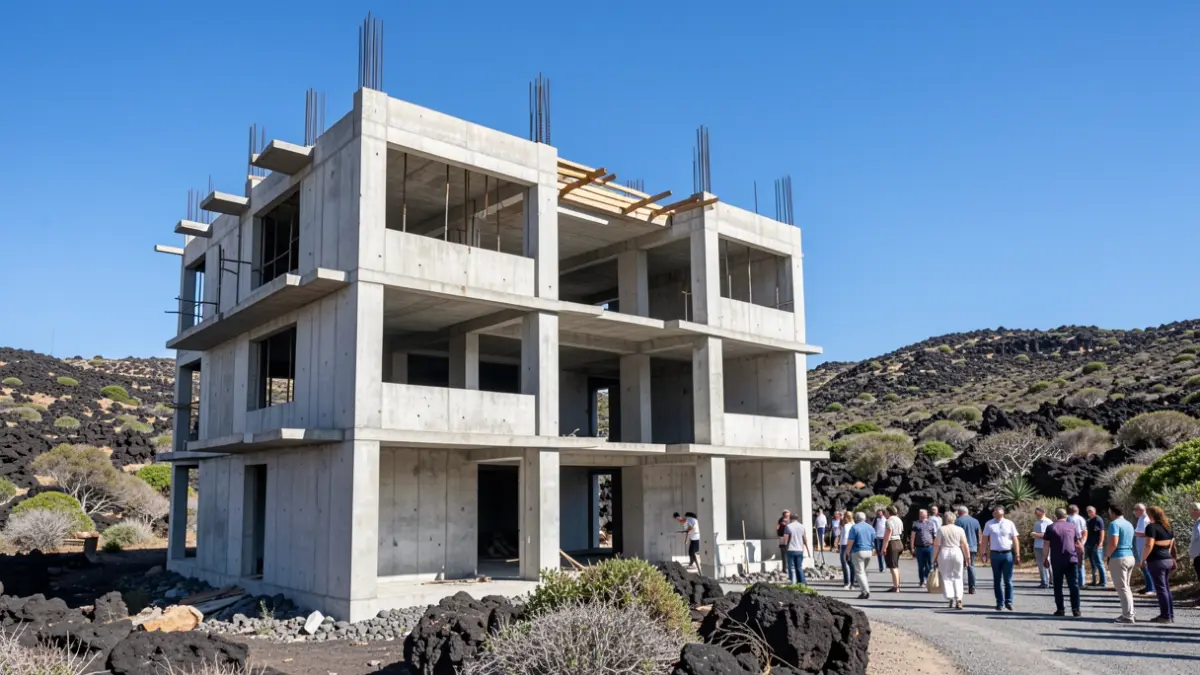
The company Hoteles Nuevo Milenio, which sold a controversial concrete structure to the Mogán City Council for 1.59 million euros for social housing, carries debts exceeding one million euros and has only one employee, according to its latest accounts filed with the Mercantile Registry for 2024.
The firm purchased the concrete skeleton in 2022 from Criteria Caixa, the investment arm of CaixaBank. This was an unfinished construction that, in the early 2000s, caused significant damage to an 18th-century manor house. The exact transaction amount is kept confidential by the administration.
In the purchase agreement between both parties, all amounts, including the price and IGIC (Canary Islands General Indirect Tax), are crossed out. The City Council, led by Onalia Bueno (Juntos por Mogán), acknowledged acquiring the property based solely on this document, according to a report from the Heritage Department.
Councilor Juan Manuel Gabella (Nueva Canarias) requested a full copy of the deed for the building, located at Guardia Juan Martín Quesada street. The Heritage Department responded that it only had the copy provided by the seller, with the amounts redacted.
A businessman from southern Gran Canaria, Juan Manuel Pérez León, has filed an appeal alleging that Hoteles Nuevo Milenio paid significantly less, around 425,000 euros, implying a profit of over one million euros in a few years.
Hoteles Nuevo Milenio, established in 2001 with a share capital of 13,830 euros, had Julio Méndez as its sole administrator, who succeeded Eugenio Hernández, a defendant in the 18 Lovas case. The company lists its main activity as retail sale of motor vehicles, despite its real estate business object.
The 2024 accounts show an average of one permanent employee with a personnel cost of 72,171 euros. The company's total assets amount to 2.3 million euros, with debts exceeding one million, of which 534,000 euros are long-term and 529,560 are short-term.
The acquisition of the concrete structure by the Mogán City Council is funded by the Government of the Canary Islands through a 2.5 million euro grant from the Canarian Institute of Housing (ICAVI). The external appraisal that valued the structure at 1.59 million euros did not mention the historic manor house demolished 25 years ago by Braum Rott SL.
The City Council had previously ordered the restoration of the legal order and physical reality concerning the historic manor house, but no sanctioning file was opened, nor was the matter referred to the Public Prosecutor's Office. The restoration order remained unfulfilled.
The transaction includes two cadastral plots: one for the concrete structure (owned by Hoteles Nuevo Milenio) and one for the demolished manor house (owned by Braum Rott SL). However, the registry and cadastral information do not match, and the City Council is not listed as the owner of any adjacent properties to the historic manor.
NC councilor Juan Manuel Gabella has expressed doubts about whether the City Council has formally acquired the historic manor house, Casa de Florita, demanding immediate clarification. Councilor for Heritage, Consuelo Díaz, gave conflicting accounts regarding the entirety of the purchase.
Businessman Juan Manuel Pérez León has filed a request for an administrative review of the operation, alleging possible economic overvaluation and questioning the effective transfer of the Casa de Florita. He also notes the absence of a valuation for the manor's restoration.
Pérez León also questions the property's location relative to the Mogán Ravine, suggesting a possible historical occupation of the watercourse, despite the City Council's technical defense.
The municipal government maintains that the operation is fully justified, arguing that rescuing the building is the most logical and sustainable option to expedite the delivery of social housing.