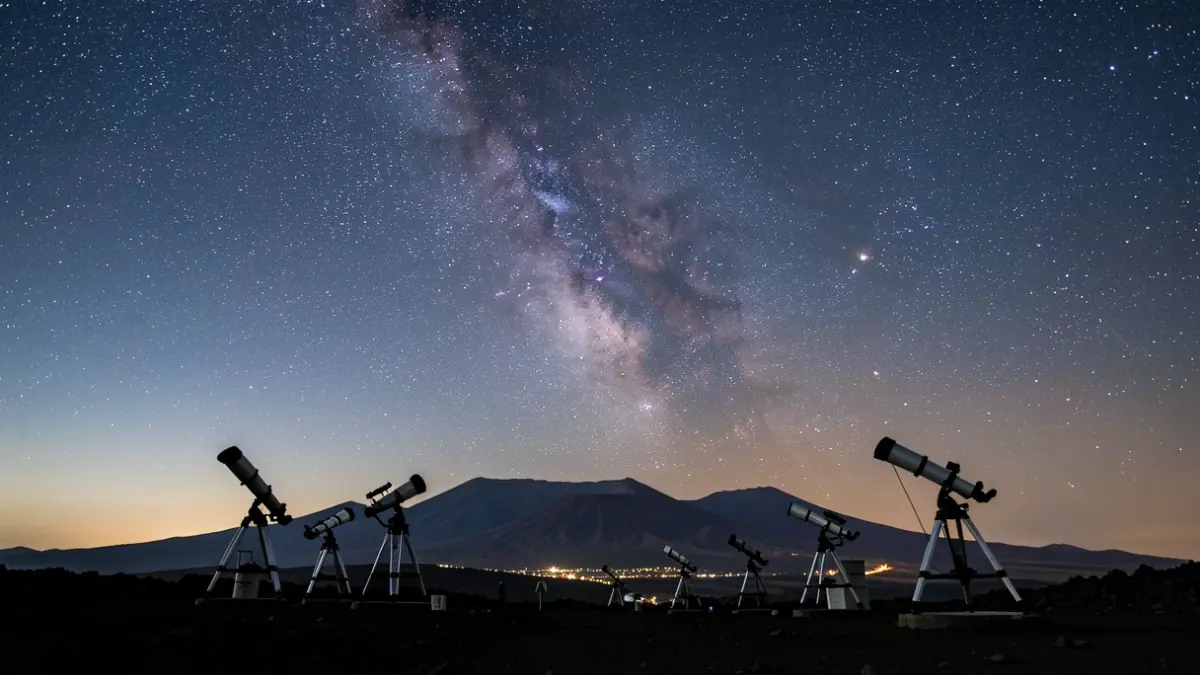
The Canary Islands receive 18 million travelers each year, and astrotourism is emerging as a value-added experience. According to ISTAC data, approximately 600,000 visitors annually, or 4.3% of the total, participate in stargazing activities. On islands like La Palma, this percentage rises to 17%. Currently, there are 60 companies dedicated to this type of tourism, with 30 of them located in Tenerife.
These general figures were provided by Carlos Fernández Hernández, a professor in the Department of Applied Economics and Quantitative Methods at the University of La Laguna, specializing in tourism. He has led the summer course at the University of Adeje, titled “Creating astrotourism experiences with telescope handling,” in collaboration with Juan Antonio González Hernández, head of the SODEPAL La Palma astrotourism program, SL.
The proper development of this niche tourism activity requires qualified professionals. Juan Antonio González explains that the initial momentum in the Canary Islands came from amateur astronomers. A key milestone was the 2007 Starlight Foundation meeting in La Palma, which led to a training program for astrotourism guides. One of the challenges for these professionals is differentiating astronomy from astrology and deterring UFO seekers.
Carlos Hernández highlights the growing interest, noting that this is the fifth course organized by the University of La Laguna on observing the sky with astronomical instruments. He cites the professional qualification program at the University of La Serena (Chile) as a best practice, suggesting that the Tenerife institution could explore similar avenues through micro-credentials, complementing existing certifications from the Starlight Foundation.
The course has focused on creating astrotourism products involving telescope handling, designing experiences around celestial elements observable with the naked eye or with instruments. Contrary to popular belief, it is not an excessively expensive hobby; with equipment valued at around 2,000 euros, one can practice astrotourism with a certain depth, according to Carlos Hernández.
José Antonio González details that the training has covered basic naked-eye observation, such as tracking meteor showers, and the use of binoculars to observe deep-sky objects. It also included notions of observation programming and the use of an 8-inch telescope.
The training includes two practical activities: a two-hour night observation at the Mirador es Ifonche, explaining the itinerary, activity development, group positioning, and telescope operation. Previously, a safe solar observation was conducted using a special filtered telescope.
Astrotourism allows for the design of multiple products, from basic excursions to visits to major infrastructures like the observatories of the Canary Islands Institute of Astrophysics on El Teide and El Roque de los Muchachos, although the latter have restrictions as they are operational professional facilities. Other options include astronomical viewpoints, stays in rural houses, themed dinners, tours for senior tourism, and VIP experiences combining gastronomy with night itineraries.