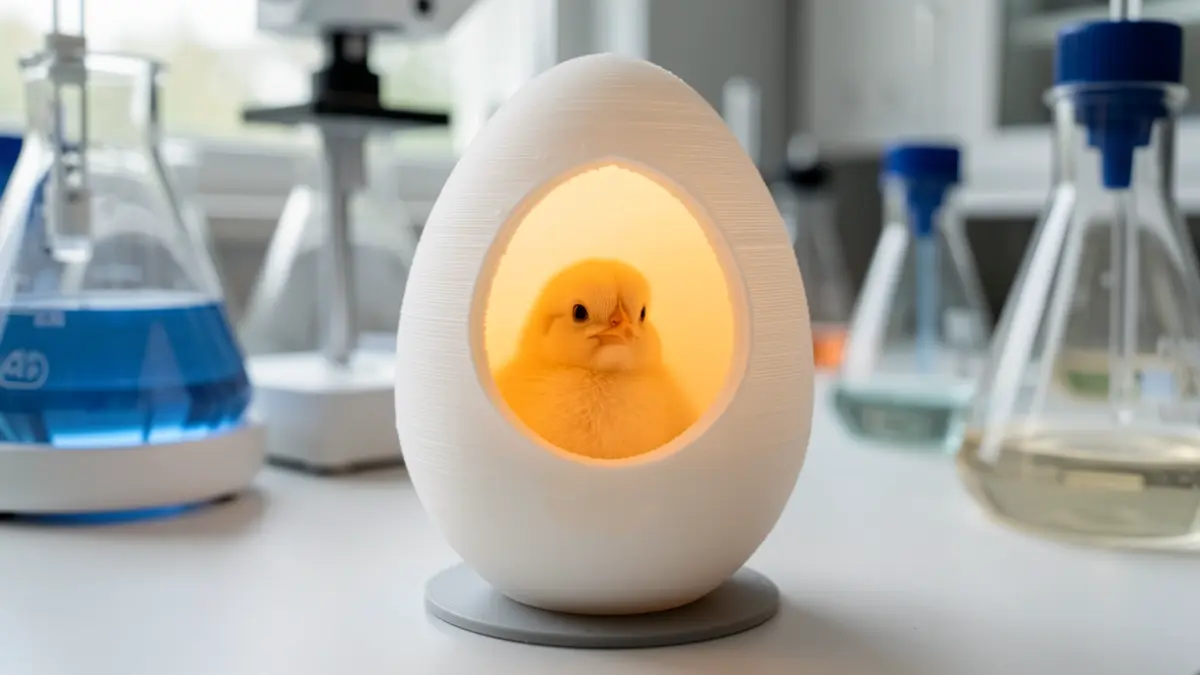
US-based Colossal Biosciences, known for its ambitious genetic engineering projects aiming to 'resurrect' species like the mammoth and the giant moa, has announced a significant breakthrough: the hatching of chicks in artificial eggs. This achievement, resulting in 26 chicks aged from a few days to several months, utilizes a 3D-printed lattice structure that mimics an eggshell.
Colossal Biosciences' technology has already been used to genetically modify living animals, creating mice with mammoth-like fur and wolf pups resembling extinct species. The company's CEO, Ben Lamm, suggested that this artificial egg technology could be expanded to genetically modify living birds to resemble New Zealand's extinct giant moa, known for its exceptionally large eggs.
“"We wanted to create something that nature has already developed successfully, but by improving it, making it scalable and even more efficient."
However, independent scientists express skepticism about the biological viability of 'de-extinction'. Evolutionary biologist Vincent Lynch from the University of Buffalo notes that the structure created by Colossal, while impressive, lacks essential components to be considered a true artificial egg. "They might be able to use this technology to create a genetically modified bird, but it will only be a genetically modified bird. It will not be a moa," he stated.
The incubation process involved placing fertilized eggs into the artificial system and adding calcium, simulating shell absorption. Colossal scientists designed a membrane allowing adequate oxygen passage, but Lynch emphasizes the absence of crucial temporary organs for nourishing and waste removal of the developing embryo.
Researchers like Nicola Hemmings, from the University of Sheffield, point out that creating transparent eggshells to study chick development is not new. She stresses that Colossal has a long way to go, needing to compare ancient DNA with living bird genomes and develop a larger eggshell before attempting to revive the moa.
Beyond technical feasibility, questions arise about the survival of such species in today's world. Arthur Caplan of NYU Grossman School of Medicine poses the challenge: "What environment will this animal live in?" Some experts, like Hemmings, suggest that de-extinction strategies might be more applicable to currently endangered species, preserving gametes to boost their populations.