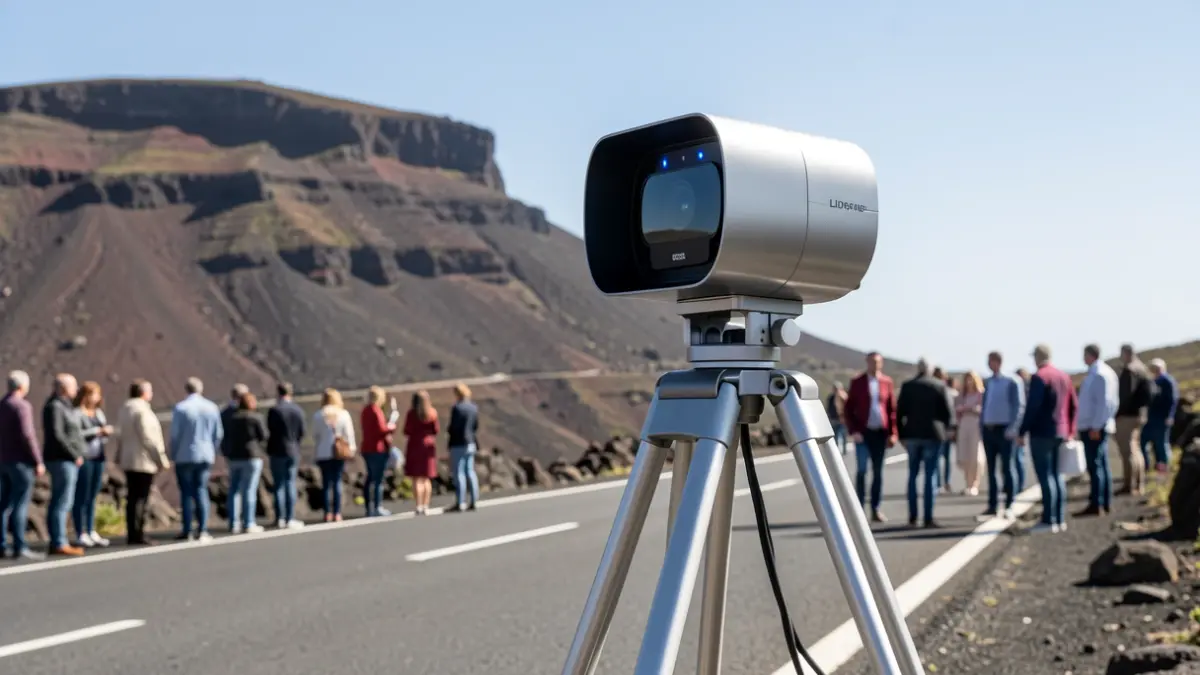
These advanced devices emit invisible light pulses that bounce off vehicles, allowing for extremely precise speed calculation. The total investment for the acquisition of 15 units has amounted to 1,020,000 euros, with the contract awarded to the company Tradesegur, an authorized distributor of systems from the German company Jenoptik, at a unit cost of 83,000 euros per unit. The new units are expected to be operational within a maximum of four months, coinciding with the summer campaign.
Unlike conventional speedometers that operated with planar LiDAR, measuring speed on a single plane and lane, the new radars are three-dimensional. According to intelligent transport systems expert José Eugenio Naranjo, this evolution generates a LiDAR point cloud that provides a complete view of the road. The system not only calculates speed but also analyzes the vehicle's volume and movement, differentiating between trucks and cars to apply appropriate speed limits, and improving the detection of motorcycles.
Effective detection is around 200 meters, although their range can reach up to 1,200 meters, controlling up to six lanes simultaneously in both directions. As these are mobile devices, they can be deployed on tripods or patrol vehicles, preventing their location in public databases. Furthermore, their laser technology is not detectable by jammers. They have an autonomy of 12 to 16 hours and operate day and night, without a visible flash, and include functions to detect mobile phone use or the absence of seatbelts.
Regarding privacy, Naranjo confirmed that drivers are only identified in case of an infraction. The DGT justifies the measure by recalling that the severity of road injuries increases exponentially with speed. These devices are in addition to existing surveillance resources such as section control radars, traffic light radars, and DGT drones.