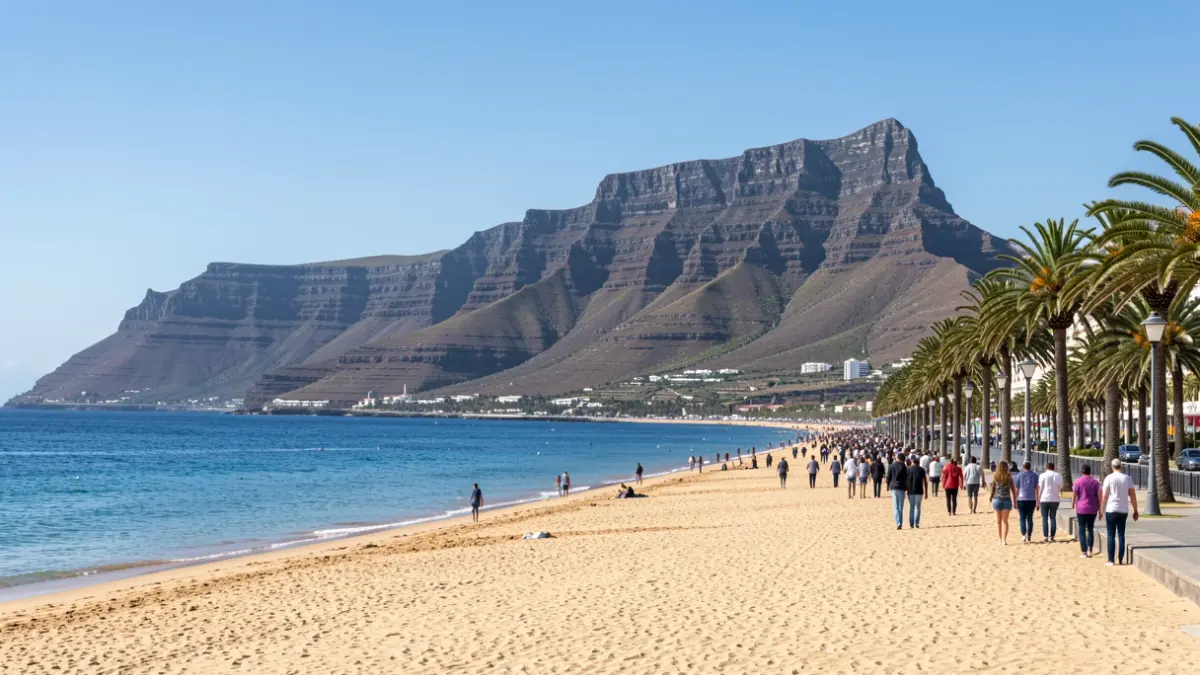
The iconic Las Teresitas beach, whose construction was completed on June 15, 1973, represented a radical transformation of the coastline of San Andrés, a town located seven kilometers from Santa Cruz de Tenerife. Half a century ago, this coastal area consisted of three beaches: Traslarena, El Moro, and Las Teresas, along with estates dedicated to growing bananas, tomatoes, avocados, and mangoes. The landscape was completed by a military battery from 1940 and a cemetery.
Traslarena beach, the closest to the urban center, was a meeting point for residents and extended to a cemetery that housed the remains of 40 victims of the 1893 cholera epidemic. Access to El Moro, located behind a castle from 1706, required walking along a dirt track and navigating a stretch of pebbles before reaching the sand, an effort that bathers considered worthwhile.
The third beach, Las Teresas, derived its name from the ravine that flowed into it. It was accessed via a dirt path. While it boasted a carpet of fine black sand in winter, pebbles deposited by the high tide were abundant in summer. This location featured a house built by Felipe Alberto, Duke of Würtemberg, for his wife María Teresa, Archduchess of Austria. This site witnessed the honeymoon of Princess Diana of Orléans and Duke Charles in September 1960. Today, only remnants of that construction remain, such as part of a parapet and walls, alongside two Indian laurels that still provide shade in the nearby parking area.
The project to create a major tourist center on this coast, approved by the Ministry of Housing in 1961, was promoted by the Santa Cruz de Tenerife City Council. Construction began in 1967 after the establishment of the Compensation Board, leading to the new Las Teresitas beach, measuring 1,300 meters long and 80 meters wide. To form it, five million sacks of sand were transported from the Sahara, at a cost of 50 million pesetas. A cutting step was implemented at a depth of 12 meters to prevent sand dispersion, despite initial rumors about the sand's origin.
Protection against strong waves was ensured by a kilometer-long breakwater, constructed with large rocks and bordered by two lateral jetties. The beach, inaugurated in 1973, was equipped with numerous amenities: parking for 300 vehicles, restrooms, showers, kiosks, restaurants, sun loungers, and sports and children's areas. Currently, its vegetation includes tamarisks, date palms, and coconut trees, and its facilities have been modernized.
Despite its development, the history of Las Teresitas has been marked by legal and administrative disputes, such as the well-known 'caso Teresitas' (Teresitas case), which affected beachfront urbanization plans.