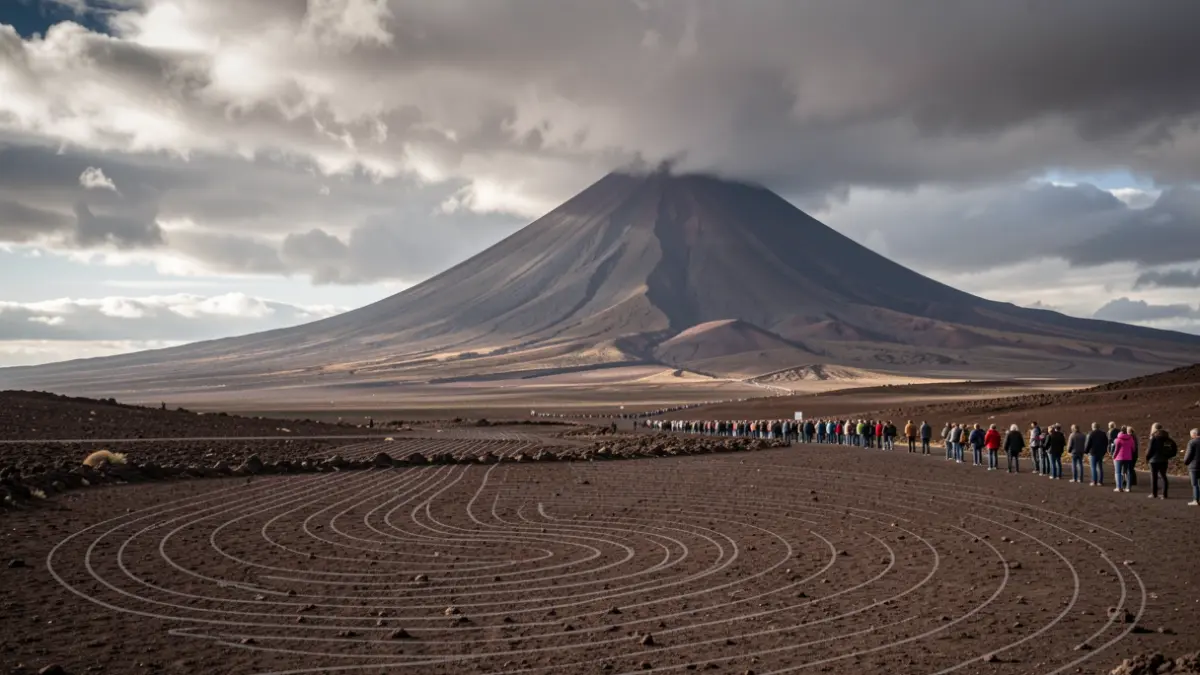
The advisory committee for the Special Plan for Civil Protection and Emergency Response for Volcanic Risk of the Autonomous Community of the Canary Islands (PEVOLCA) has concluded that the current seismovolcanic activity in Tenerife could result in earthquakes perceptible to the population. However, this situation does not imply any indication of an imminent eruption in the short or medium term.
The committee's spokesperson, Itahiza Domínguez, explained that an increase in seismovolcanic activity, such as that observed in Tenerife for the past six months, can generate earthquakes that the population can feel. He clarified that these events would not cause damage unless there was a magmatic intrusion, which cannot be entirely ruled out.
The director of the IGN in the Canary Islands, Itahiza Domínguez, stressed that current conditions do not warrant raising the volcanic risk alert to orange, although this decision rests with the regional administration. Gas emissions have decreased, and ground deformation is minimal, only two centimeters over three years.
The earthquakes that could be "lightly felt" by the population would, in principle, be related to the Las Cañadas del Teide area, should they occur. Domínguez specified that it is not being stated that they will happen.
Domínguez also addressed the popular theory about whether low-intensity activity in Las Cañadas could prevent a larger earthquake, describing it as "neither positive nor negative" and attributing it to popular belief.
The spokesperson for the Pevolca advisory committee emphasized the importance of remaining "attentive," especially considering that historically, seismic activity felt by the population has preceded eruptions in Tenerife. Currently, no felt events are being registered, and the exact position in the activity cycle is unknown.
Should continuous and felt earthquakes begin to occur, a special committee would be convened, as it would be a "worrying" situation.
Domínguez underscored that in volcanology, there are no "mathematical formulas," and that a certain magnitude earthquake or several in an hour do not predict a specific event. "It doesn't work that way," he stated, explaining that multiple variables such as deformation, ground temperature, and gas emissions must be considered cautiously.
The change that would be "worrying" in the current phase of anomalous activity would be the occurrence of seismic events at shallower depths and of much greater magnitude, or rapid ground deformation, scenarios that are not currently being observed.
The events recorded in June and July mark a "return" to the anomalous activity that began in February, after several months of a pause. Volcanologists have 20 years of data, and Tenerife's volcanic system historically experiences an eruption every hundred years, making it difficult to predict the current situation.
It has been noted that current activity exceeds the levels of a year ago, and those of ten years ago. The spokesperson for the Pevolca advisory committee reiterated the request for the public to follow official information and scientific organizations for data closest to reality.
He acknowledged that constant information is not always available, but in this stage of anomalous activity, which "is not yet worrying," they are providing "all that we can."