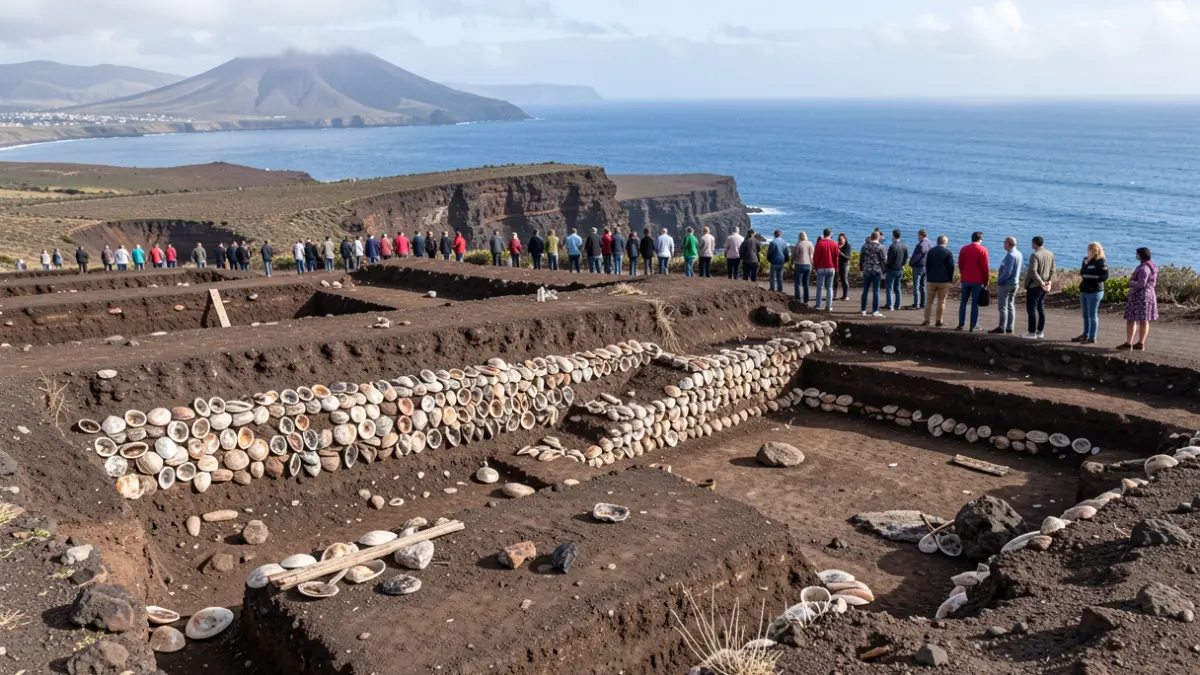
The coast of Buenavista del Norte, in Tenerife, has emerged as a key site for understanding the relationship between Guanche populations and the coastline. Research from the University of La Laguna (ULL) has reconstructed nearly a thousand years of marine resource exploitation and analyzed the transformation of the Isla Baja landscape since initial settlement.
Results published in the scientific journal The Holocene indicate continuous mollusk collection between the 2nd and 12th centuries, employing sustainable strategies adapted to the coastline. This offers new perspectives on natural resource management by Tenerife's aboriginal communities.
The study was co-directed by ULL researchers Álvaro Castilla Beltrán and Cristo Manuel Hernández Gómez, with a multidisciplinary team from the Chair for Disaster Risk Reduction and Resilient Cities, the Laboratory of Archaeological Micromorphology and Biomarkers (AMBI Lab), the Insular Ecology and Biogeography group, and the Prehistory and Archaeology of Space and Time group (PAST). Collaborators also included the Directorate General of Cultural Heritage of the Government of the Canary Islands and Tibicena, Arqueología y Patrimonio.
The ULL has worked for over two decades in the area, identifying habitation caves, burial sites, and around a hundred shell middens—deposits of mollusks like limpets and winkles—evidencing the Guanche connection to the sea.
Cristo Manuel Hernández Gómez highlights that mollusk exploitation was a fundamental economic activity and that the project analyzes shell middens as records of landscape evolution, not just as sites for resource processing.
The methodology combines the analysis of malacological remains with plant microfossils (pollen, phytoliths) to reconstruct changes in coastal vegetation and human interaction with the territory over time.
Álvaro Castilla explains that the goal was to extract landscape information beyond mollusk processing. The work reveals changes in coastal scrubland and thermophilic species associated with human action, providing insights into early coastal landscapes and their current conservation.
The study dated shell middens and associated materials from terraces between the 2nd and 12th centuries, confirming the longevity of these practices. The interdisciplinary dimension, involving archaeology, geography, and ecology, allows for interpreting the landscape as a dynamic reality and strengthens the connection between citizens and their historical and natural heritage.
The project also plays a crucial role in student training, with contributions from undergraduate students, final degree projects, and postdoctoral researchers. Hernández Gómez emphasizes that field research is an ideal framework for understanding the islands' past and for student education.
One such student is Joel Pérez Ruiz, studying History, whose final degree project analyzes the spatial relationship between shell middens, habitation caves, and coastal exploitation areas in Buenavista del Norte, identifying adaptive and sustainable strategies in marine resource use.