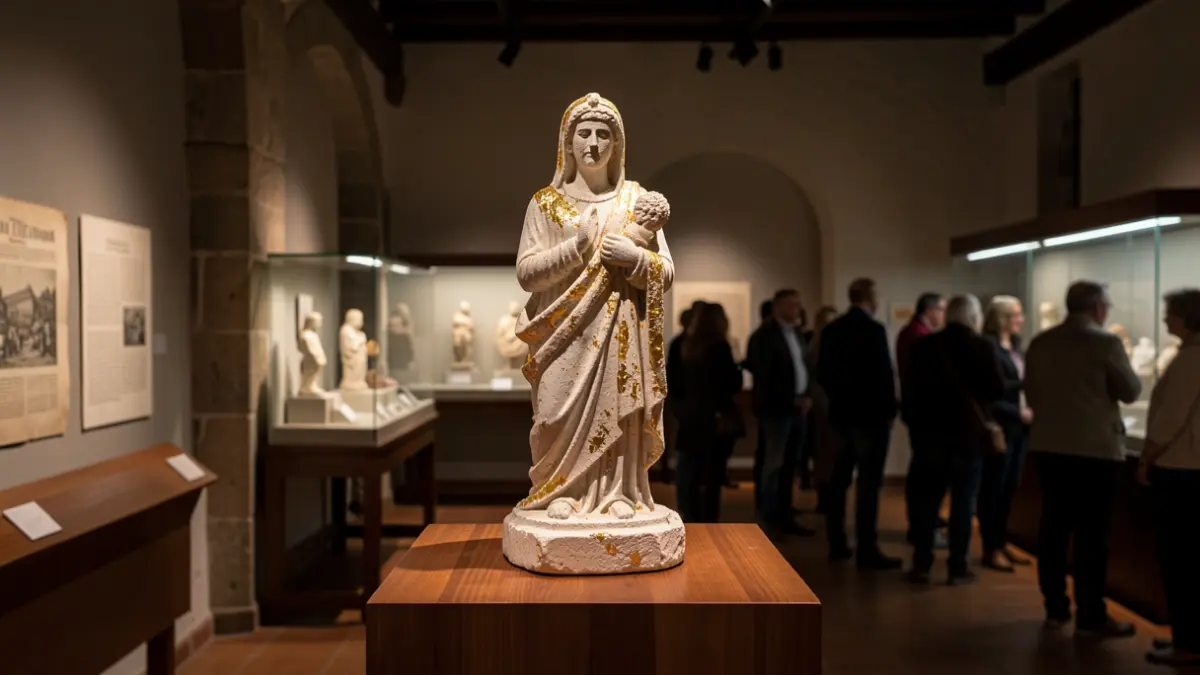
The sculpture, created from historical documentation and traditional plastic arts techniques by the Fine Arts department of the General Foundation of the University of La Laguna, will be a central element of the commemorative exhibition set to open on November 9. The exhibition will open its doors to the public on Wednesday, November 4.
The original image was lost at sea during the storm that hit Tenerife on the night of November 7-8, 1826, when floodwaters reached the Dominican convent of Candelaria. The sculpture, a devotional icon for centuries, was never recovered.
The mayor of Candelaria, Mari Brito, highlighted the historical and cultural value of the initiative, calling it a significant contribution to the bicentennial exhibition. The reconstruction is based on documentary sources and historical pictorial representations, with particular attention to the descriptions by friar Alonso de Espinosa.
The project combines contemporary 3D modeling and printing tools with traditional artistic procedures such as stucco, gold leaf gilding, and polychromy. The replica aims to reproduce the details described by friar Alonso de Espinosa, considered a key reference for understanding the primitive image.
The initiative involved collaboration with historians from the Institute of Canarian Studies, such as Carlos Rodríguez Morales and Jesús Rodríguez Bravo, and was directed by Itahisa Pérez Conesa, a professor of Sculpture at the University of La Laguna, with research by Alejandro Hernández Pérez.
This reconstruction serves a historical and educational purpose, not to replace the current image of the Virgin of Candelaria, created by Fernando Estévez in 1830. The goal is to allow citizens to approach what the sculpture lost two centuries ago might have looked like, contributing to the dissemination and preservation of the municipality's collective memory.