Las Palmas de Gran Canaria considers opening blue zone to loading and unloading
The City Council and business leaders are collaborating to redesign urban goods distribution and improve mobility.
By Jonay Mesa Rodríguez
••3 min read
AI
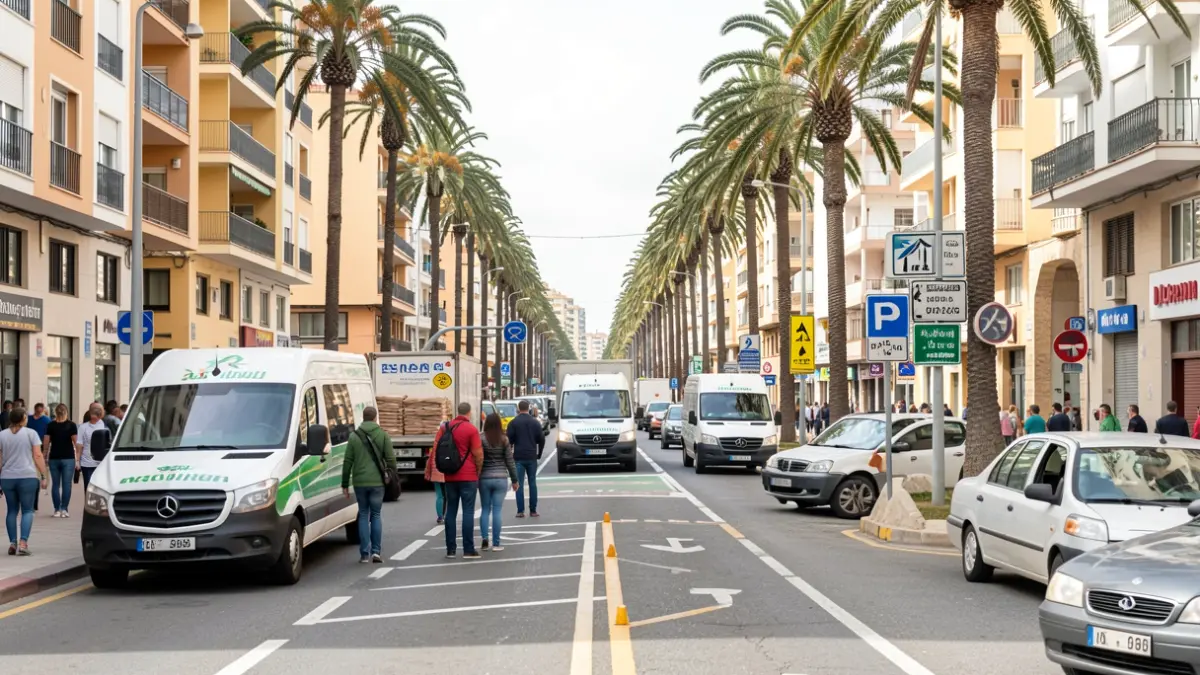
Image of an urban street in Las Palmas de Gran Canaria with delivery vehicles and regulated parking zones.
The Las Palmas de Gran Canaria City Council, along with business leaders, is promoting a new protocol to regulate urban goods distribution, considering opening the blue and green zones to transport.
The Las Palmas de Gran Canaria City Council is evaluating the possibility of allowing loading and unloading tasks in regulated parking zones (blue and green zones). This initiative is part of a collaboration protocol with business leaders to transform the city's urban goods distribution model, aiming for greater efficiency and sustainability.
Among the proposals to be put forward are the use of taxi stands for these purposes before the start of commercial hours, adjustments to distribution schedules, and the creation of strategic collection points across the city. The goal is to achieve a more peaceful and orderly integration of goods transport into urban traffic.
The Councilor for Mobility, José Eduardo Ramírez, signed an agreement with the director of the Logistics and Transport area of Aecoc, María Tena. This agreement will lay the groundwork for joint work aimed at defining a new logistics model tailored to the city's needs.
A field study will be conducted to identify the needs of shops, businesses, and citizens. Based on this information, a master plan for urban goods distribution will be developed, which will complement the future Sustainable Urban Mobility Plan.
“
"There will be companies or distributors that need more time, others that need less time. Therefore, we will also have to regulate these hours to know how long they can occupy the blue and green zone and that they can be controlled by the controllers. It will be without payment, but there will be time control so that the space is not occupied for longer than necessary."
To implement these measures, it is crucial to determine the necessary occupation time for each activity in different zones, the traffic volume generated by the Port, and the percentage of urban movements attributable to goods transport. The new collaboration agreement will seek to clarify these unknowns.
The City Council expects to complete this work before the end of the year, from which new proposals will emerge, such as the digitalization of loading and unloading or the establishment of specific spaces in the city.
“
"Las Palmas de Gran Canaria brings together a combination of factors that make it particularly important to address urban goods distribution from a strategic perspective. Its status as a major urban and commercial hub, along with high tourist activity and intense daily travel, requires moving towards more agile, efficient, and sustainable logistics models capable of responding to the city's needs without sacrificing the quality of the urban environment."
“
"It is a proposal that the city needs, that the city demands, that we can frankly improve goods distribution, and it will not be just for professionals, but for the city in general. We can achieve better distribution and more reasonable work, and also more efficient use of space. I believe it is good for us and good for everyone."