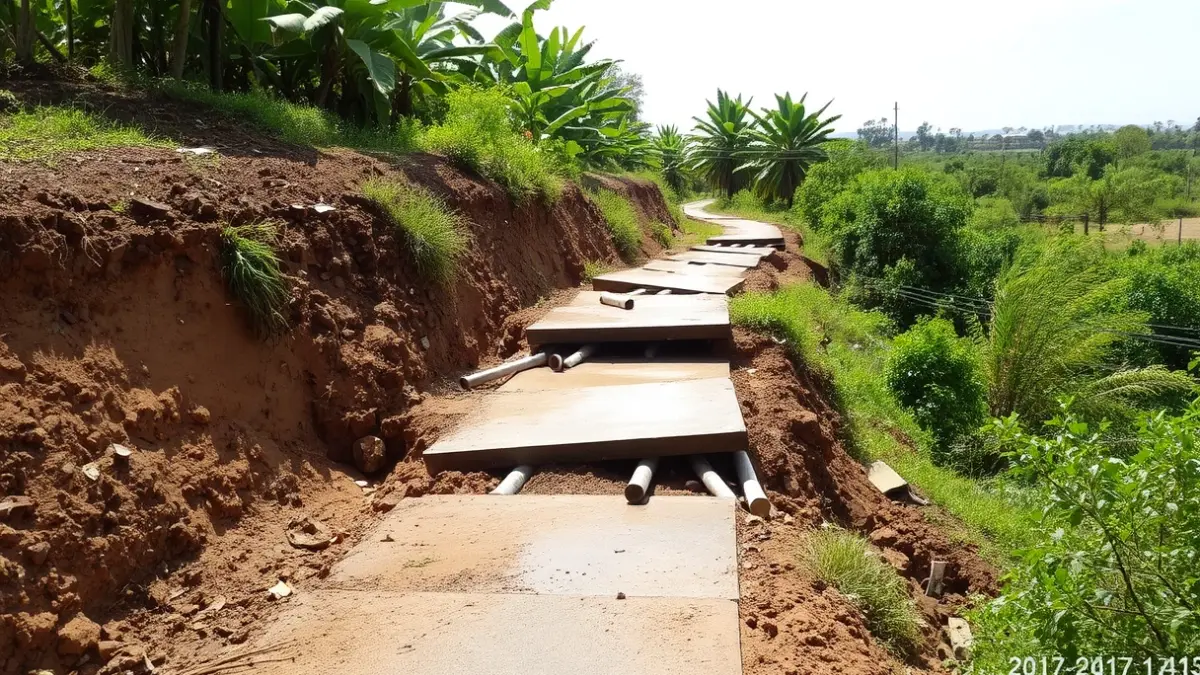
The Guiniguada Ravine, known as the green lung of Las Palmas de Gran Canaria, fulfilled its role as a natural watercourse during the unusual storm. However, the passage of Therese and its powerful water discharge caused entire sections of the path, which stretched over seven kilometers, to disappear.
A representative from the Department of Strategic Development, Sustainability and Energy, Parks and Gardens, and Primary Sector, along with technical staff from Gesplan, inspected the area this week to assess the extent of the damage and determine the necessary actions for its restoration. The route revealed the critical state of the path, with impassable sections and drops of up to 70 centimeters, where the water overflowed natural channels and erased traces of the original trail.
In addition to the natural devastation, the inspection also highlighted the presence of rubbish and construction debris, a problem that exacerbates the ravine's condition and is attributable to the incivility of some citizens. The walls and makeshift fences of private banana plantations also succumbed to the force of the water.
“"Therese was the third significant storm in recent months and the one that had the most impact on the ravine."
The recovery of Guiniguada, with its 7.5 kilometers of accessible path leading to the Jardín Canario, presents a considerable challenge due to its length and historical neglect. The damage caused by Therese has intensified the need for an intervention that will require time and resources. Initial estimates for the work, already valued at 900,000 euros, are now deemed insufficient after further inspections.
The City Council was already working on a project to restore the main path, with funding from FEDER funds, which will now need to be adapted to include the repair of the storm damage. The goal is for the ravine to be accessible to walkers and cyclists, while maintaining its essence as a natural space and minimizing the impact of interventions.
Guided tours through the ravine, which were offered for all ages, have been suspended until conditions allow for safe passage. The recovery of this space is fundamental for the Las Palmas de Gran Canaria City Council, which aims to activate Guiniguada as a pillar of its environmental policy, connecting the cliffs with its central axis and creating a circular route for citizens to learn about its natural and hydraulic heritage.