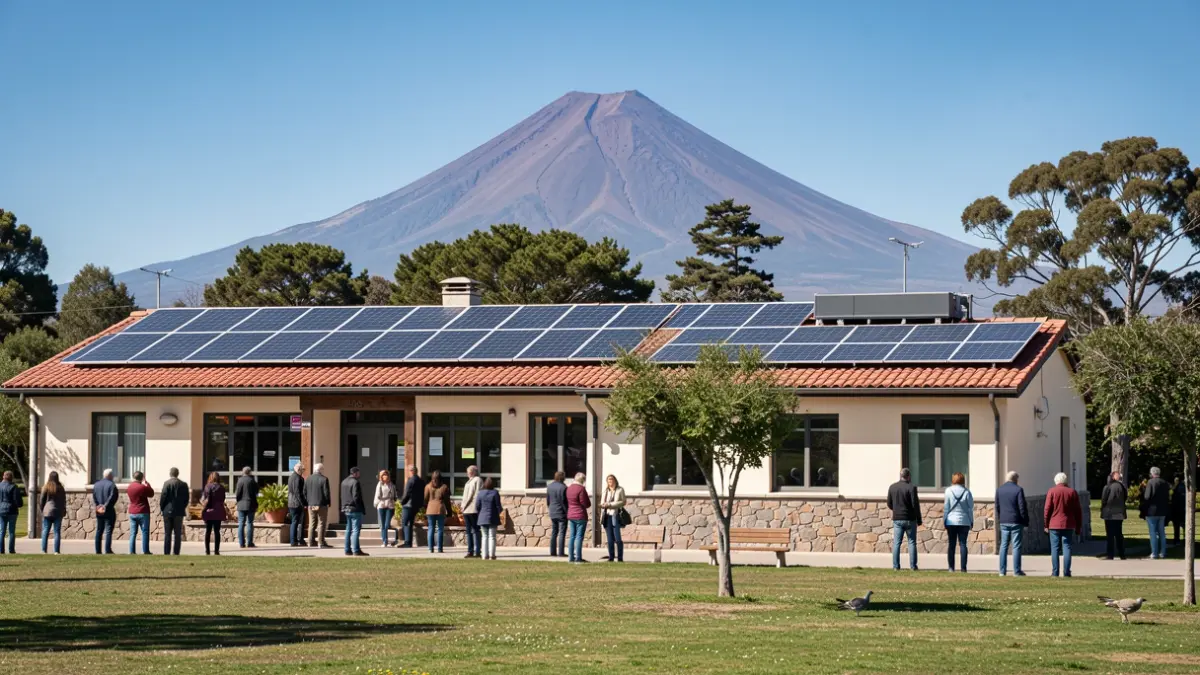
The Department of Ecological Transition and Energy of the Government of the Canary Islands, led by Mariano Hernández Zapata, has finalized the implementation of a photovoltaic generation system with battery storage. This initiative will provide clean and autonomous energy to the public buildings located between El Portillo Alto and El Portillo Bajo, in the Teide National Park.
The project, carried out by the public company Tragsa and financed with Next Generation funds, involved an investment of nearly 500,000 euros. The new system eliminates the reliance on diesel generators, ensuring a continuous 24-hour electricity supply.
“"We demonstrate that the energy transition also reaches our natural spaces, improving public services with environmentally friendly solutions."
During a visit to the facilities, the minister highlighted the compatibility between protecting natural spaces and energy innovation. "We continue to demonstrate that the protection of our natural spaces is fully compatible with innovation and the energy transition. Incorporating renewable energies in a unique environment like the Teide National Park allows us to improve public services, reduce environmental impact, and move towards more sustainable management of our national parks," he stated.
This new installation has transformed the operation of the facilities in El Portillo, which previously relied on diesel generators. The new system, based on solar energy and battery storage, provides a stable and permanent supply, enhancing both energy efficiency and service reliability.
The project involved implementing an isolated microgrid connecting the public buildings in El Portillo. The storage system guarantees supply even without solar production, drastically reducing fossil fuel consumption and associated emissions.
This initiative is part of the investments by the Department of Ecological Transition and Energy to modernize the management of the Canary Islands' national parks through renewable energy, energy efficiency, and emission reduction solutions, thereby strengthening the conservation of the Archipelago's environmental heritage.