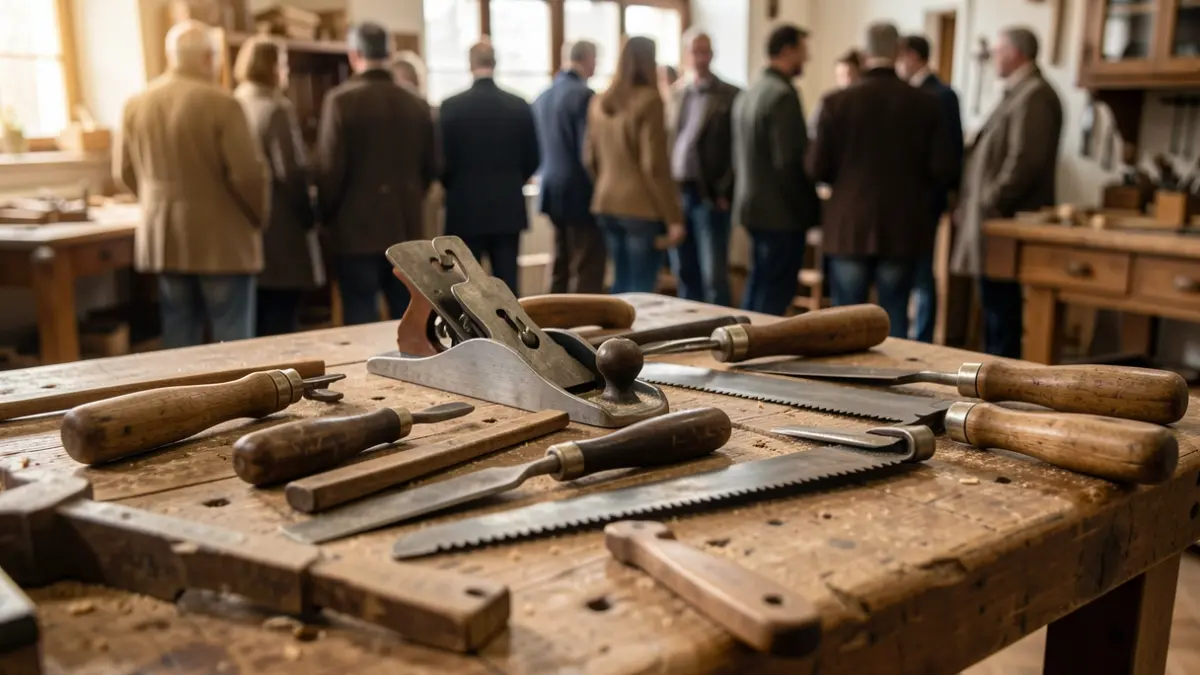
The exhibition not only displays traditional tools and pieces but also gives voice to some of the last carpenters keeping this art alive. Through their memories, visitors discover a profession where patience, wood knowledge, and artisanal work dictated the daily rhythm.
Manuel Almeida, 82, recalls how from the age of ten, he alternated between a mechanical workshop and a carpentry shop, learning the trade out of passion. He explains that crafting a complete bedroom set—wardrobe, bed, dresser, and nightstands—was an artisanal process that took weeks. Carved furniture, costing between 10,000 and 12,000 pesetas, was a lifelong investment. Almeida admits the trade has changed so much that he advised his grandson Alejandro to pursue anything but carpentry, reflecting the difficult generational handover.
Simeón Santana, 92, started at fourteen working with his brother, a master woodcarver. Among his early works were small jewelry boxes that 'young people gave to their sweethearts,' pieces where wood also spoke of affection. Jesús Pérez Romero, son of carpenter Agustín Pérez Quintana, has dedicated over five decades to the craft. He highlights the profession's profound transformation: 'Before, it was all saws, planes, and sandpaper. Today, machines do almost everything.' Pérez notes that the issue isn't just technology but changing consumer habits, as 'no one pays for the work involved in a completely handmade piece anymore'.
Competition from industrial manufacturing and large commercial chains has led to the closure of most traditional workshops, with barely one carpenter dedicated to this craft remaining in Ingenio. However, Pérez finds hope in the restoration of traditional homes and the preservation of historic centers, which necessitates recovering wooden doors and elements that are part of the municipality's architectural heritage.
Sebastián Viera Martín, 77, humorously recalls that carpenters were easily recognized because many had lost a phalanx in the workshop and, jokingly, 'they were liars, never meeting delivery dates.' Behind the anecdote lay the reality that each piece required time and work that could not be rushed.
Beyond nostalgia, the 'Rincón de los Oficios' invites reflection on the value of work where each piece of furniture was unique, designed to last for decades and accompany a family's life. Contrasting with the culture of immediacy, the exhibition, open in the hall of the Villa de Ingenio town hall, champions patience, knowledge passed down through generations, and respect for a heritage that forms part of the municipality's identity.