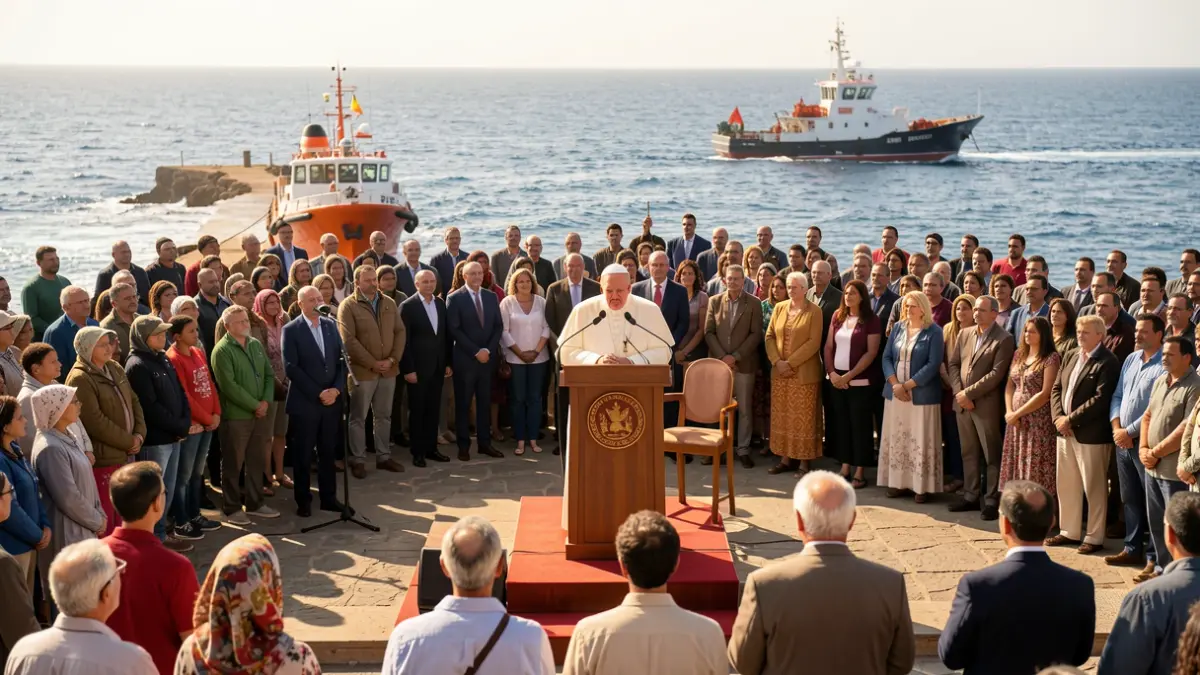
In a moving event held at the port of Arguineguín, Pope Francis issued a stern rebuke to Europe: 'You cannot proclaim human dignity and become accustomed to the Atlantic and the Mediterranean being cemeteries without tombstones.' His words echoed among the approximately 2,000 people, mostly migrants, who gathered to remember and honor those involved in the migration phenomenon.
The Pontiff, considered a global moral reference, used his visit to gain firsthand knowledge of migration realities and to assign responsibilities. Among those present was the President of the Government of Spain, Pedro Sánchez, who listened attentively to the papal address just hours before the new European migration pact, described by some as lacking solidarity, came into effect.
Pope Francis also directed his 'homework' to the Church itself, demanding that migrant reception should not be a secondary task or solely delegated to volunteers. This firmness was reinforced by direct testimonies from individuals who had experienced the harsh journey, many of them rescued at sea after days adrift in precarious boats from Africa.
Heartbreaking accounts, such as that of a trafficking victim who spoke through another migrant for security reasons, moved those present. Tito Villarmea, captain of Salvamento Marítimo (Maritime Rescue); María Reyes Alemán, a volunteer from Cáritas; and María Fernanda López, a Latin American businesswoman, also shared their experiences.
The event, organized by Cáritas Diocesana, included a moving floral offering to the sea in memory of those who did not reach their destination. The Pope, visibly affected, cast flowers into the water as 'Nube de hielo' was played on the timple. Subsequently, about 50 young migrants repeated the gesture.
The visit to Arguineguín, the Pope's first destination in Gran Canaria, was attended by numerous authorities, including the President of the Canary Islands, Fernando Clavijo, and the mayor of Mogán, Onalia Bueno, who presented the Pontiff with an artisanal rosary.
The gathering, which paid tribute to the victims of the Canary route, the deadliest in the world, aimed to highlight the migratory reality through images and testimonies, with the sea as a backdrop, a symbol of both danger and hope.
The event concluded with the blessing of a cross made from cayuco wood, placed next to a carving of the Virgen del Carmen, the patron saint of sailors.