Tenerife South Airport faces the challenge of adapting its facilities to ever-increasing traffic. The infrastructure recorded a total of 13,969,678 passengers in 2025, a 1.7% increase from the previous year, and 92,309 operations, both historic figures. This consolidates its position as the second-busiest airport in the Canary Islands, surpassed only by Gran Canaria.
Located in Granadilla de Abona, in Tenerife's main tourist area, the airport is a crucial gateway for foreign visitors. The rise in traffic has not only boosted its economic importance but also intensified pressure on the terminal and airport processes.
A notable characteristic of Tenerife South is the predominance of international connections, with the United Kingdom and Germany accounting for over half of the total passenger movement. This reliance on the international market is linked to the tourism model of southern Tenerife, generating high demand and concentrating flights in specific time slots.
Airport capacity depends not only on the annual number of passengers but also on the distribution of daily flights, the availability of aircraft parking positions, and the efficiency of check-in, boarding, baggage claim, and other terminal processes.
Despite the designations 07 and 25, the airport operates with a single runway measuring 3,200 meters in length and 45 meters in width. This infrastructure, designated 07/25 depending on the direction of takeoffs and landings, limits the simultaneous operation of departures and arrivals, reducing flexibility during incidents or adverse weather conditions.
Inaugurated in 1978, Tenerife South Airport is approaching 14 million annual passengers, ranking among the busiest airports in Aena's Spanish network. Between 2024 and 2025, passenger numbers rose from 13,740,411 to 13,969,678, consolidating the volume achieved after the recovery of air traffic.
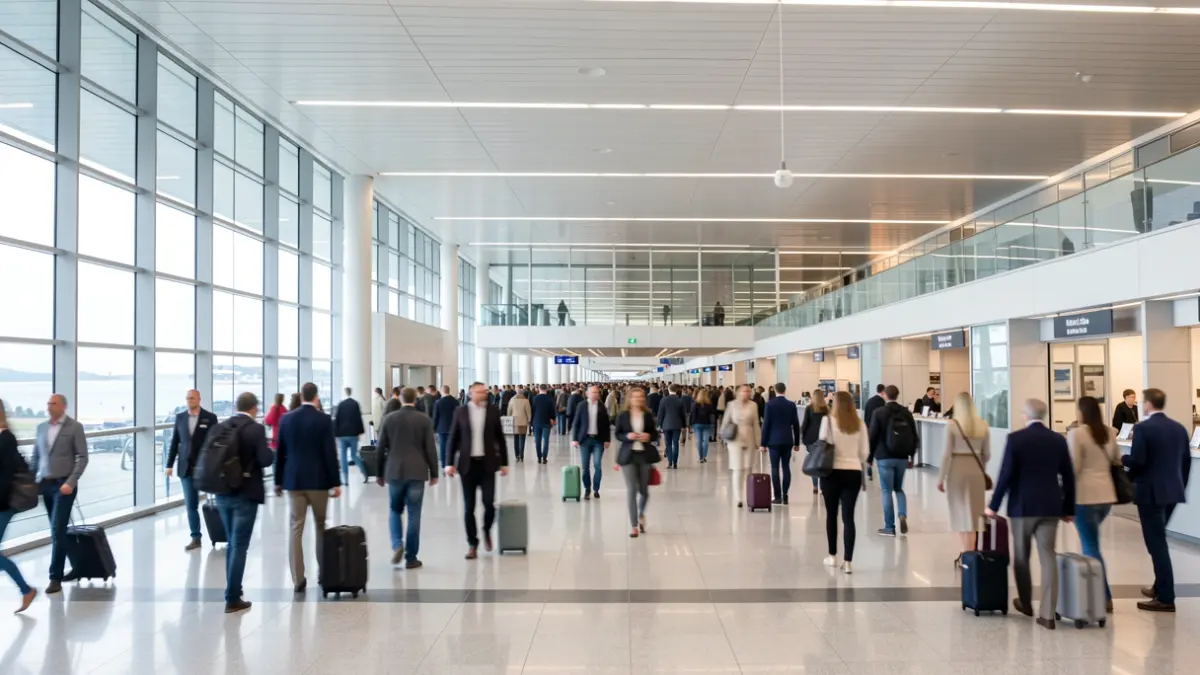
The pressure extends beyond the runways, affecting the terminal, check-in and boarding areas, baggage halls, border controls, aircraft parking, and ground access.
Aena has planned significant investment for the airport within the 2027-2031 regulatory period (DORA III), allocating 553.6 million euros, compared to the 68.9 million for the 2022-2026 period. The main action will be the comprehensive renovation of the terminal area to increase its capacity through expanded surfaces, reorganized operational processes, and new technologies.
The project also includes improvements to parking facilities and connections with other modes of transport. The most significant works will commence between 2027 and 2031, although the complete transformation will extend into the following investment cycle.
This expansion is crucial for an island whose connectivity heavily relies on air transport. The airport supports a large part of the tourism mobility in southern Tenerife, directly impacting hotels, shops, restaurants, and service companies. The challenge is to adapt the facilities to the projected passenger growth without compromising service quality, thereby streamlining passenger transit.
Tenerife South will continue to be a key entry point to the Canary Islands. Its future evolution will depend on the planned investments keeping pace with traffic growth, maintaining a balance between tourism expansion, the island's connectivity, and the actual capacity of its infrastructure.