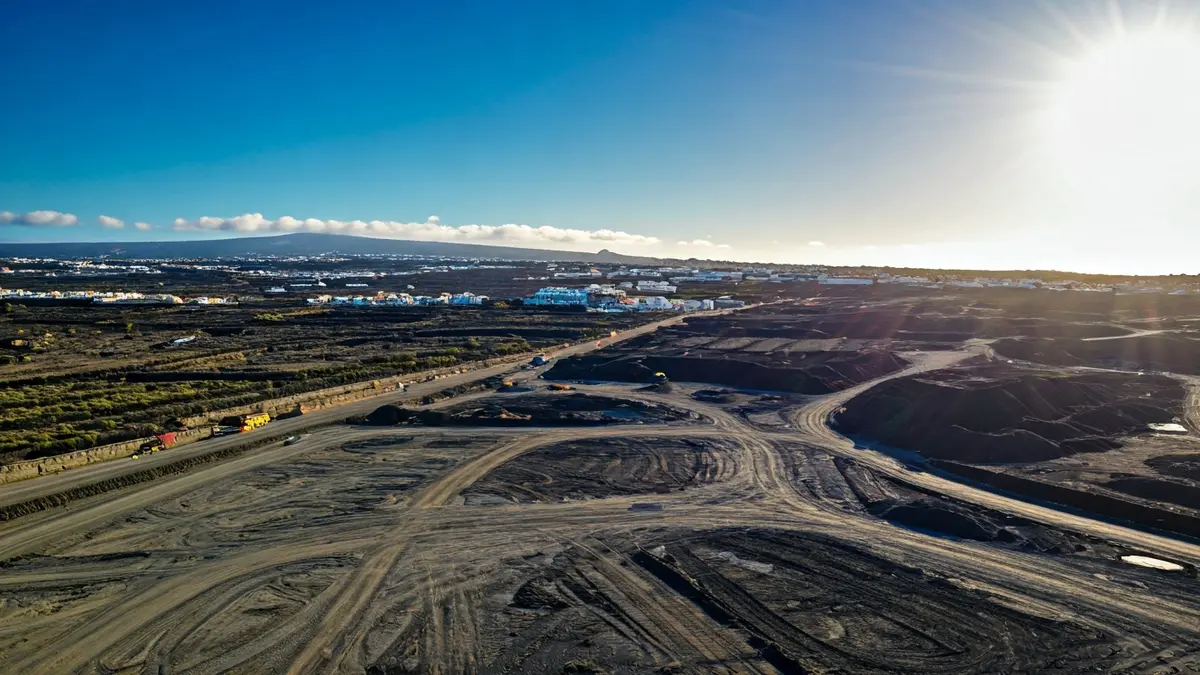
The document, prepared by a multidisciplinary team of nine experts and submitted by the popular accusation Asociación Cultural Social Ecologista Puertito Libre, concludes that almost 300,000 square meters of land, 66.8% of the total, have suffered direct impact from the works or are located in plots that, according to the report, violate regulations. The developer, Segunda Casa Adeje SL, has not responded to inquiries about these findings.
The study details that earth movements have created two large spoil heaps of 348,000 and 115,000 cubic meters. Additionally, 17.9 hectares of irrigated agricultural land, valued between 1.5 and 2 million euros, have been lost, along with 3.8 hectares of vegetation that annually absorbed 63 tons of carbon dioxide (CO2). It is anticipated that upon completion of the urbanization, 8.2 hectares that captured 136 tons of CO2 will have been eliminated.
The Geological Site of Interest (LIG) ‘Ignimbritas y depósitos de caída plinianos pleistocenos del Puertito de Adeje’ has lost 25.1% of its surface due to excavations. The authors warn that future damage could reach 75.5% of the LIG, implying the elimination of complete eruptive phases from the geological record, making future study impossible.
This means that complete eruptive phases have been eliminated from this record, so their study will not be possible in the future when we will surely have analytical techniques far superior to those we currently have.
The report also indicates that 15.5 of the 265 hectares of Llano del Camello, a priority area for the reproduction of threatened species declared in 2015, are already damaged. It is estimated that the works will affect 44.9 hectares, fragmenting the space due to the construction of 3,600 tourist beds. Regarding the viborina triste, a specially protected plant, 21.2% of its population centers have already been destroyed, and 91% of its habitat in the area is expected to disappear, with no scientific evidence of successful translocation.
Furthermore, the Habitat of Community Interest (HIC) of scrubland and tabaibales has decreased by 25.4%, about 3.76 hectares, with damages described as “constant and irreparable.” The urbanization could consume 55% of this HIC. Of the 57 heritage assets found, 13 have disappeared or been damaged, including aboriginal archaeological sites, ethnographic elements, and a traditional Canarian house. Another 11 assets are at risk of disappearance due to lack of valuation studies, and 18 have an “uncertain future” awaiting approval of a museum area proposed by the Cabildo de Tenerife.
The document also warns of future marine impacts, such as increased maritime traffic near the protected area Franja Marina Teno-Rasca, which would increase the risk to turtles, dolphins, and tropical pilot whales. Modifying the beach with sand could affect sandbanks and underwater caves, as well as seagrass beds. The potential installation of a Wastewater Pumping Station (EBAR) near the beach poses a risk of sewage discharges into El Puertito bay.
Finally, the report mentions the lack of environmental assessment for the project, the strategy of the Adeje City Council to authorize the translocation of the viborina triste under the pretext of the housing crisis (despite the project not including public housing), the expropriation of the Galindo family, and the conflict of interest of the former president of Adeje's environmental body, Rosendo López, who simultaneously worked for the developer.