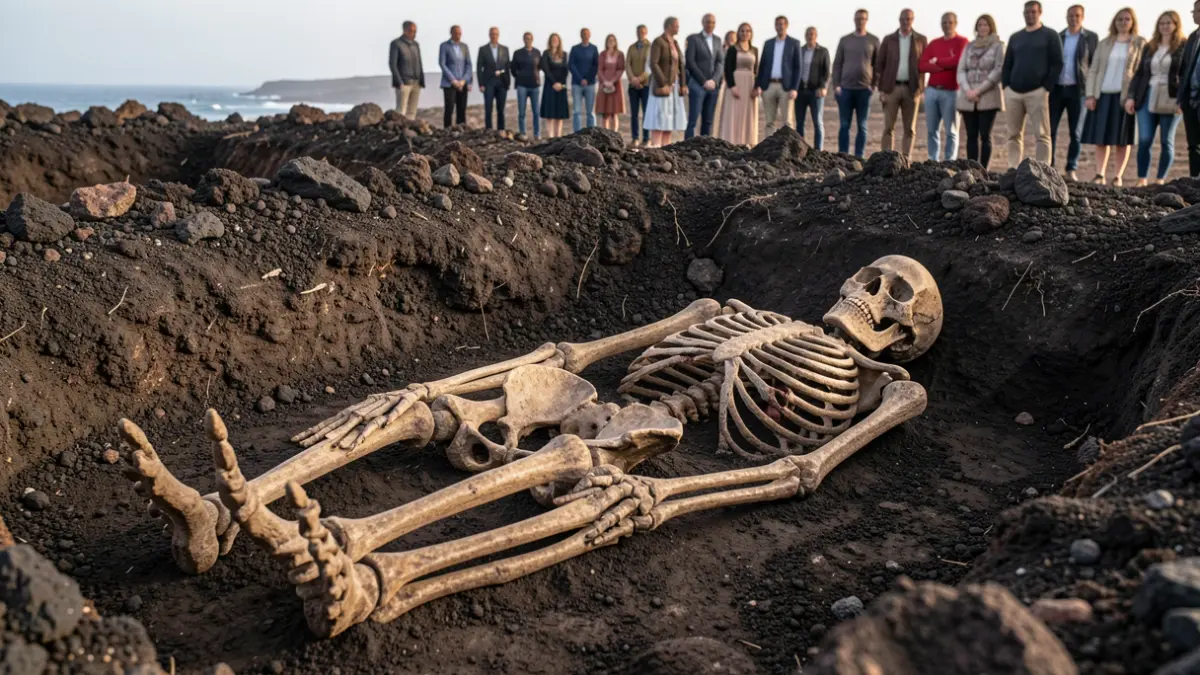
An interuniversity study, conducted within the Rubicón Project by the University of La Laguna and the University of Las Palmas de Gran Canaria, has documented a case of Paget's bone disease in the skeleton of an adult male buried in the early 15th century at San Marcial de Rubicón, Lanzarote. This finding represents the first permanent European settlement in the Canary Islands and one of the earliest archaeological examples of this disease outside Europe.
The research, published in the journal International Journal of Paleopathology, analyzes how this chronic illness may have affected an individual during the initial decades of European colonial expansion across the Atlantic. The study expands the geographical record of the condition and offers insight into the bodily consequences of a long-term disease within a frontier population.
The studied individual, designated Individual 10, was recovered from a burial area excavated in 2023. It is a male over 40 years old, whose nearly complete skeleton exhibited abnormalities such as cranial thickening, new bone formation, curvature of the humerus and femur, complete sacroiliac fusion, and advanced knee osteoarthritis. The analysis combined macroscopic observation, X-rays, CT scans, and ancient DNA analysis.
Results revealed accelerated and disorganized bone remodeling consistent with polyostotic Paget's disease. This pathology disrupts the normal bone renewal process, leading to thicker, deformed, and sometimes more fragile bones. After differential diagnosis, the pattern of lesions is most compatible with this chronic condition.
Skeletal deformities and joint deterioration suggest prolonged uneven weight-bearing and compensatory biomechanical adjustments, although the remains do not allow precise determination of pain levels or functional limitations. Pronounced development of arm muscle insertions might relate to habitual activities but does not identify specific tasks or the use of walking aids.
The burial followed the general pattern of the cemetery, with no grave goods or differentiated funerary treatment, indicating the individual did not receive special treatment. Mitochondrial DNA analysis identified the X2c1 haplogroup, compatible with European maternal ancestry, though nuclear DNA data was insufficient for studying genetic susceptibility.
San Marcial de Rubicón, founded in 1402, provides with Individual 10 early bioarchaeological evidence of Paget's disease in an Atlantic colonial setting. The research team included specialists from the ULL, ULPGC, Universiteit Leiden, and Baraka Arqueólogos S. L., coordinated by Jared Carballo-Pérez with participation from Selene Rodríguez-Caraballo, Rosa Fregel, Esther Chávez-Álvarez, among others.